

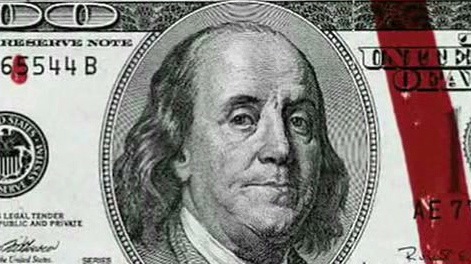
Zeitgeist: Addendum| 2hr : 03mins
Director: Peter Joseph | Producer: Peter Joseph
Focus Years: 2008 | Country: United States
Synopsis:
"Zeitgeist: Addendum" follows on from "Zeitgeist: The Movie." Part III from the original film, citing the specific process of fractional-reserve banking as detailed in "Modern Money Mechanics", released by the Federal Reserve Bank of Chicago. In detailing the process of so-called money creation in banks, the film suggests society is manipulated into economic slavery through debt-based monetary policies by requiring individuals to submit for employment in order to pay off their debt. Part II is a documentary-style interview with The New York Times best-selling author and activist John Perkins based on his book, "Confessions of an Economic Hit Man", in which he explains his role as a self-described economic hit man. In that capacity, he claims to have helped the CIA, as well as various corporate and political entities, to undermine or corrupt foreign regimes that put the interests of their populations before those of transnational corporations. Perkins denies the existence of a conspiracy, because he sees the U.S. as a corporatocracy, in which there is no need for a plot, as politicians like Dick Cheney, who first was a self professed "public servant" congressman, secretary of defense then served as the head of a construction company Halliburton before becoming Vice President) are alleged of working under the same primary assumption as corporations: that maximization of profits is first priority, regardless of any social or environmental cost.
Part III is a documentary-style interview with futurist Jacque Fresco. The film looks at Fresco's proposal of a "resource-based economy", which he claims would create abundance, is environmentally friendly and sustainable. He goes on to discuss technology which he sees as the primary driver of human advancement and he blames politics as being unable to solve any problems, because of what he claims is lack of "technical capabilities". Fresco claims that his approach is not perfect, but that "it's just much better than what we have. We can never achieve perfection".
Part IV of the film suggests that the primary reason for what it sees as society's social values ("warfare, corruption, oppressive laws, social stratification, irrelevant superstitions, environmental destruction, and a despotic, socially indifferent, profit oriented, ruling class") is a collective ignorance of "the emergent and symbiotic aspects of natural law." The film suggests several actions for "social change", which include: boycotting banks who are claimed to make up the Federal Reserve System, such as JPMorgan Chase and Citibank, turning off TV news, not joining a military, refusing energy from energy companies in favour of making homes self-sustainable with clean energy and rejecting the political structure. The film closes by asking everyone to "eliminate the divisionary, materialistic noise, we have been conditioned to think is true ... while discovering, amplifying and aligning with the signal coming from our true, empirical oneness."
Zeitgeist: Addendum
|
2hr : 03mins
Search information, ideas, subjects related to this story:
Wikipedia :
Other Articles/Sites :
Explore Wikipedia:
Send funds to team of this film/project:
NOTE: 100% of your funds are sent directly from here.

Close
This storyteller has yet to share/set a wallet for the direct fund transfers.
Shall we send an email request on your behalf?
Close
peace