
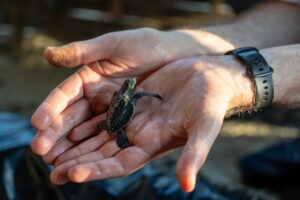
COX'S BAZAR, Bangladesh, Apr 20 2026 (IPS) - Every winter thousands of sea turtles come ashore at Cox’s Bazar, in the Bay of Bengal, Bangladesh, to lay eggs.
Their path to their breeding grounds is hazardous – fishing nets, propellers, light pollution, coastal developments, stray dogs and other dangers conspire against their success.
The area is rich in biodiversity, with five out of seven ancient reptiles present in Bangladesh’s waters, with three – the Olive Ridley (Lepidochelys olivacea), the Green Turtle (Chelonia mydas), and the Hawksbill (Eretmochelys imbricata) – coming ashore for nesting.
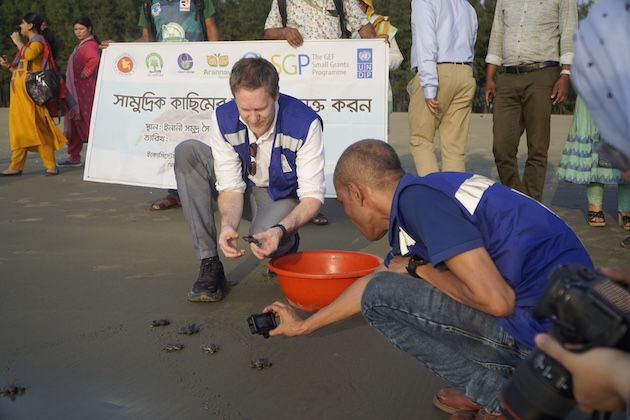
Stefan Liller, UNDP Bangladesh representative, gently releases the young turtles from the hatchery. Credit: UNDP Bangladesh
Amid such unfavourable odds for the aquatic creatures, a group of young people volunteer to protect the turtles on the beach at Cox’s Bazar during the breeding season from November to March, contributing to their successful conservation.
“In the past, we did not know how sea turtles help conserve marine ecosystems. Now we know sea turtles play an important role in conserving biodiversity,” Rezaul Karim, a resident of Shafir Beel village in Cox’s Bazar, told Inter Press Service (IPS).
Karim is one of the youths trained for sea turtle conservation under a project run by the Arannayk Foundation, a non-profit conservation organisation in Bangladesh. The foundation established a sea turtle conservation group involving 25 local youths (11 women, 14 men) under its Ecosystem Awareness and Restoration Through Harmony (EARTH) project. EARTH is supported by the Forest Department, the Department of Environment (DoE), and the United Nations Development Programme (UNDP) with funding from the Global Environment Facility (GEF).
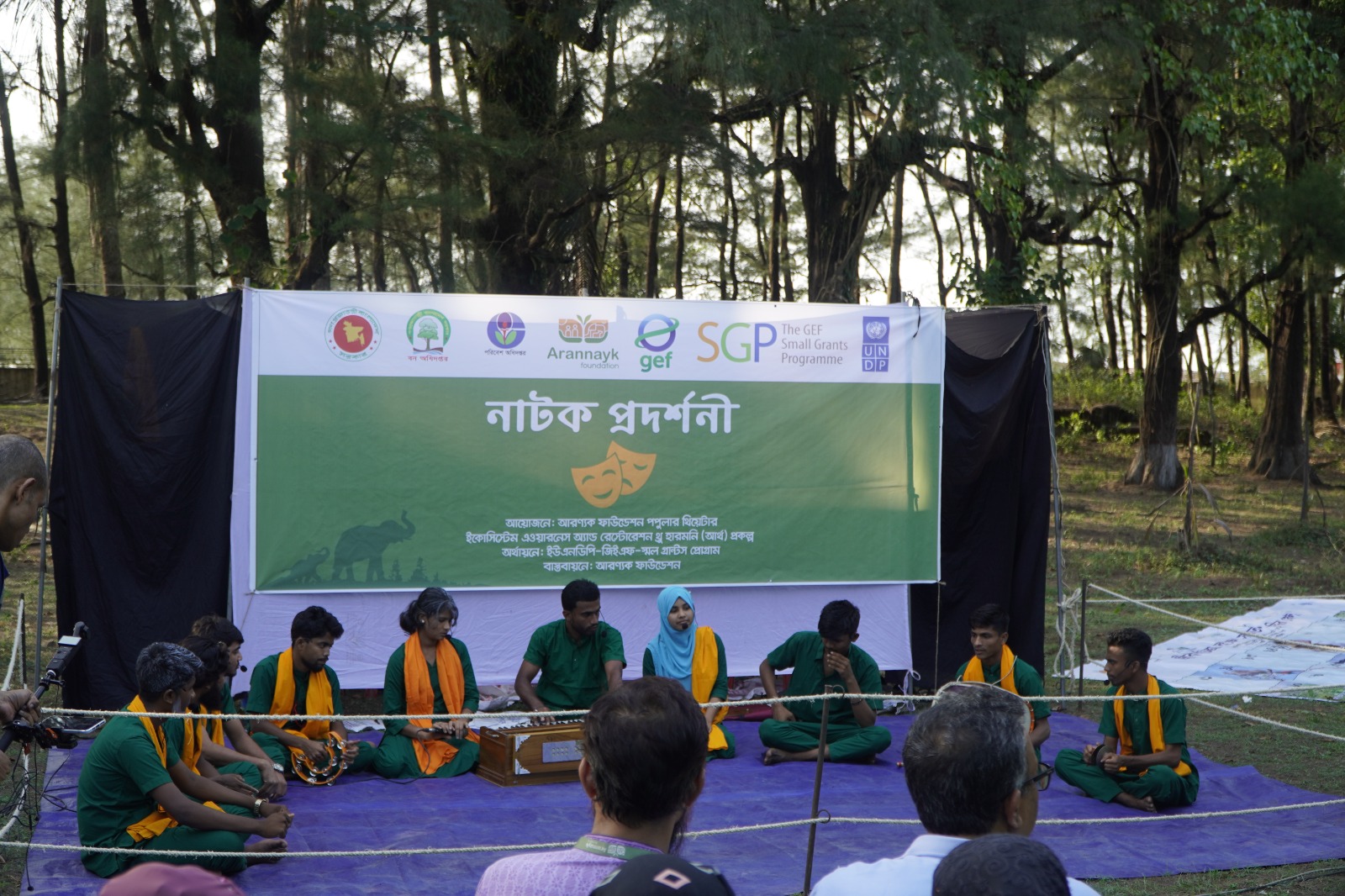
A youth group performs a play designed to sensitise the community to conservation issues. Credit: Arannayk Foundation
The group is working to raise awareness about sea turtle conservation among fishermen, youth, and the local community. They are also aiming to encourage a shift in local attitudes by engaging community members.
Group leader Delwar Hossain, a resident of Sonarpara village under Ukhyia upazila, said sea turtles play a crucial role in maintaining marine ecosystems, as different species of sea turtles help sweep or clean the ocean by managing various food sources and habitats.
He said there is a superstition among the marine fishermen that if turtles are caught in their fishing gear, it will bring bad luck and that is why they kill turtles caught in their nets.
“We held meetings with the fishermen several times and made them aware of sea turtle conservation,” Delwar said.
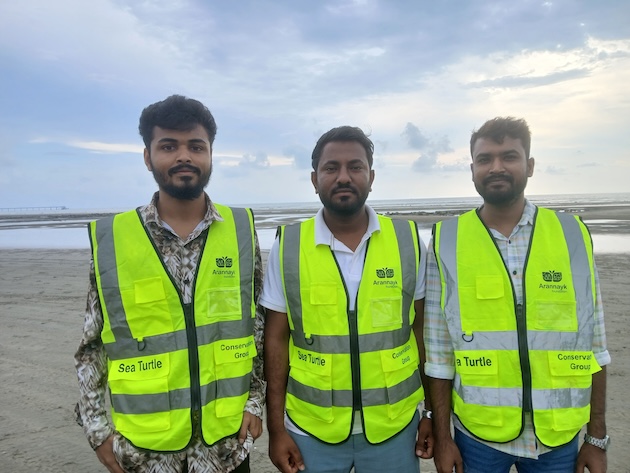
Turtle conservation group leader Delwar Hossain with others on Cox’s Bazar Beach, Bangladesh. Credit: Rafiqul Islam/IPS
Gabriella Richardson Temm, Lead of the Small Grants Program at the GEF, says civil society, Indigenous Peoples, local communities, and youth and women groups around the world “play critical roles in shaping global development agendas. They deliver transformational solutions to global environmental problems, bring rights holders and marginalised voices into national policy dialogues, and elevate local priorities in international environmental negotiations and financing.”
Indigenous Peoples, local communities, and youth and women groups around the world play critical roles in shaping global development agendas.The small grants program has served as a cornerstone of civil society engagement within the GEF partnership since its inception in 1992.
“Over three decades, the program has demonstrated remarkable reach and impact, administering over US$1.5 billion through nearly 30,000 grants to Indigenous Peoples, local communities, women, and youth across 136 countries. This extensive network has successfully secured US$990 million in co-financing, demonstrating the program’s effectiveness in mobilising additional resources for environmental action at the grassroots level,” says Temm.
Grassroots community protection has been acknowledged as contributing to the success of moving one of the sea turtles – the green turtle – to the International Union for Cons
ervation of Nature’s (IUCN) ‘Least Concern’ list. Other factors include international trade bans, reduced poaching, and improved fishing gear.
However, the species predominantly nesting in the Cox’s Bazar beaches, the Olive Ridley is classified as ‘Vulnerable’ on the IUCN Red List of Threatened Species, while the Hawksbill Turtle remains ‘Critically Endangered’ due to population declines.
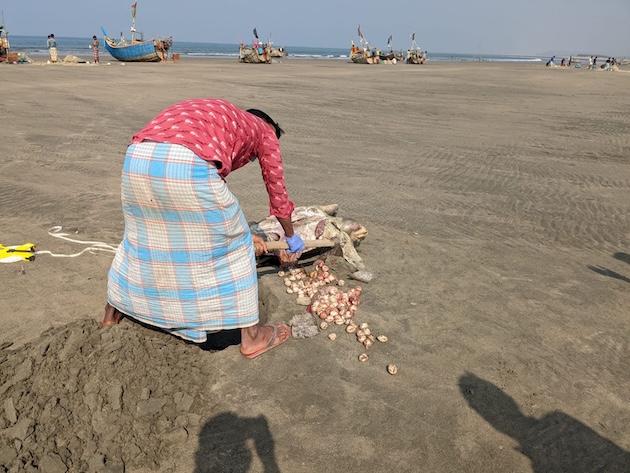
Many sea turtles don’t survive the hazardous journey to the nesting grounds at Cox’s Bazar Beach, Bangladesh. Credit: Bangladesh Forest Department
Establishment of Turtle Hatchery
In Cox’s Bazar, with the help of the foundation, the youth group surveyed a 10 km stretch from Reju Khal to Balia Khali beach to identify sea turtle nesting sites. It also gathered insights from local communities on sea turtle breeding seasons, nesting frequency, preferred locations, and community perceptions regarding conservation.
Following the assessment, a sea turtle hatchery was established in Boro Inani, Cox’s Bazar. The hatchery is now playing a crucial conservation role, as these statistics show.
Between January and April 2024, 5,878 Olive Ridley eggs were collected from various nests at Swankhali, Ruppati, Imamer Deil, and Madarbunia sea beaches, resulting in 3,586 hatchlings hatching, with an average hatching success of 61 percent.
Also, from February to April 2025, a total of 3,199 eggs were collected, and by May 2025, 716 hatchlings had been released.
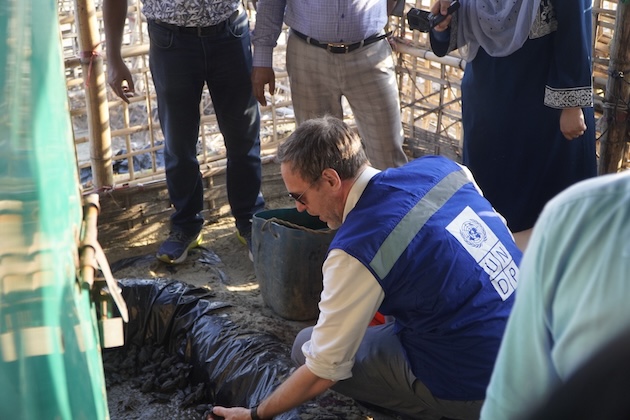
Stefan Liller, UNDP Bangladesh representative in the turtle hatchery. Credit: UNDP Bangladesh
Delwar said that stray dogs often eat the turtle eggs so the hatchery makes a significant contribution.
“We collect eggs that turtles release on the shore and bring those to the hatchery for hatching. Besides, we ask the community people to give turtle eggs to the hatchery. We, the group members, collect the turtle eggs from them too.”
Nurul Afsar, another TCG member, said many ethnic communities living in Cox’s Bazar consume turtles and their eggs – so the group plays a role in encouraging them not to consume but instead protect them.
ABM Sarowar Alam, program manager (species and habitats) at the IUCN in Bangladesh, said Cox’s Bazar Beach was once the ideal breeding ground for sea turtles, but it has dwindled due to habitat loss, poaching, and human disturbance.
He believes that several areas of the beach should be declared as “protected areas for sea turtles” to ensure safe breeding and that fishing should be restricted in the canals connecting to the sea so that turtles can move freely for nesting.
The group also addresses other hazards, such as the issue of stray dogs that kill the turtles and consume the eggs.
Firoz Al Amin, range officer of Inani Forest Range in Ukhiya, said the Forest Department has been working to control the stray dogs on the beach, aiming to protect the turtles.
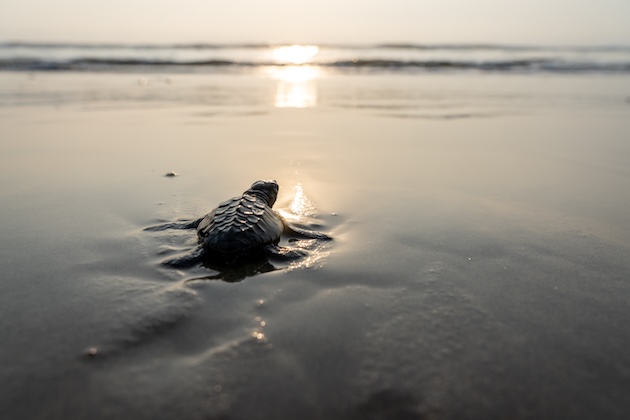
A sea turtle moves toward the sea. Local conservationists are making a difference to the future of these ancient aquatic animals. Credit: UNDP Bangladesh
EARTH Project, More Than Turtle Conservation
Dr Mohammed Muzammel Hoque, national coordinator of the GEF Small Grants Program at UNDP Bangladesh, said the EARTH project’s role went beyond turtle conservation in the region.
It has elephant-response teams to mitigate conflicts between elephants and humans. The Five Crab Conservation Groups (CCG), comprising 25 youth members, and five sea Turtle Conservation Groups (TCG), also consisting of 25 youth members, remain active. The project was also working towards restoring habitats, with over 7,780 seedlings planted with support from the EARTH Project, with around 80% surviving.
However, Hoque said that the success is dependent on funding – and it’s hoped that once a Forest Trail becomes operational, it can generate revenue from tourists.
Abu Hena Mostafa Kamal, program coordinator of the Arannayk Foundation, said the project, by integrating livelihoods with conservation, “helped grow a sense of ownership among community members and youth, ensuring that environmental protection is not just a project outcome but a sustained, collective commitment.”
Note: The Eighth Global Environment Facility Assembly will be held from May 30 to June 6, 2026 in Samarkand, Uzbekistan.
This feature is published with the support of the GEF. IPS is solely responsible for the editorial content, and it does not necessarily reflect the views of the GEF.
IPS UN Bureau Report