
SYDNEY, Apr 28 2026 (IPS) - Bangladesh remains one of the most corrupt countries in the world. Its corruption perception index (CPI) score, 24, is 18 points below the global average score of 42, and 21 points lower than the Asia-Pacific region’s average of 45. One of the main sources of corruption is over-priced aid-funded projects as they lack competitive bidding. Projects funded through Government-to-Government deals drive up costs by more than 400% compared to more transparent alternatives, and around 35% of project costs are lost to corruption and inefficiency.

Anis Chowdhury
Complicity
Development partners – traditional and non-traditional – cannot deny their complicity. The most culpable is the World Bank, followed by the Asian Development Bank (ADB) and Japan International Cooperation Agency (JICA). The shares of Bangladesh’s external debt liabilities to them are around 29%, 23% and 18%, respectively, totalling 70% of total external debt. Russia and China are Bangladesh’s main non-traditional development partners, with their respective shares of total external debt at 11% and 7%. All donors offered loans rampantly to the fascist regime to achieve their strategic and business interest, ignoring its extensive corruption and wide-spread human rights violations.
The World Bank briefly demonstrated its adherence to responsible lending principles when it cancelled $1.2 billion IDA credit for the Padma Bridge project in 2012, citing high-level corruption allegations. But its lending subsequently increased as if to expiate itself for the cancellation of the Padma Bridge loan. Mr. Hasan, one of the most corrupt ministers in the deposed Hasina Government, boasted, “once the World Bank cancelled its credit to finance Padma Bridge but now [in 2023] it has proposed to provide $2.25 billion”. To embarrass (or absolve?) the Bank, Sheikh Hasina presented a picture of the Padma Multipurpose Bridge to World Bank President David Malpass at the loan signing ceremony.
While Dhaka boasted that the Padma Bridge project was “entirely funded” by the government, China Exim Bank in fact provided $2.67 billion preferential buyer’s credit. The project costed approximately $3.6-$3.9 billion, nearly 3 times the initial estimate of $1.2 billion (the amount sought from the World Bank), largely due to corruption. The cost over-run triggered crises in both the forex and local currency markets, leading to the erosion of the country’s foreign exchange reserves.
The International Monetary Fund (IMF) provided the lifeline at the dying hours of Hasina’s kleptocratic regime when it approved $4.7 billion in January 2023 with some vague conditionality, such as raising revenues, implementing structural reforms to create a conducive environment to expand trade and foreign direct investment, deepening the financial sector, and developing human capital.
The IMF chose to turn a blind eye to widespread corruption, including the looting of banks by the regime’s cronies, gross violations of human rights and election engineering to hold on to power. Can the IMF absolve itself of responsibility for enabling the survival of the collapsing repressive and corrupt regime to commit human rights violations and abuses during the mass uprising against it a year and half later?
Old habits die hard
Corruption in Bangladesh has deep roots; corruption’s tentacles have reached almost the entire body polity of the country to become a ‘social culture’. Nevertheless, the Interim Government, led by Nobel Laureate Professor Yunus, took some bold reform initiatives to strengthen the Anti-Corruption Commission (ACC) and the integrity of the financial sector.
Thus, it is deeply disappointing that the newly elected government replaced the highly professional central bank governor with a failed business person with no background in banking or international macroeconomics within the first week of assuming power. A loan defaulter himself, the new governor immediately relaxed the loan rules. The government also amended the Interim Government’s Bank Resolution Ordinance to allow the return of the restructured banks to previous owners who looted these banks.
These changes, together with the new government’s rejection of the Interim Government’s ordinances concerning the ACC, the independence of judiciary and the human rights commission, are clear signs of the old habits’ refusal to die and the persistence of corruption.
Another old habit, i.e., addiction to loans (so-called aid), denies to die. As of April 2026, the External Relations Division (ERD) of the Ministry of Finance has been instructed to look for up to $3 billion from development partners. Interestingly, the ERD’s main activity is foreign fund searching through its ‘fund searching committee’ which meets periodically to review (code name for naming and shaming section chiefs) its monthly loan signing targets. Instead, the ERD should have been focusing on fostering and strengthening economic relations – trade and investment – as its name implies.
One direct damage of aid addiction is the lethargy in mobilising domestic resources – Bangladesh’s tax-GDP ratio (around 7%) is not only low compared with the averages for low-income countries (13.5%) and middle-income countries (18.9%), but has also been declining from its peak of around 9% in 2012 since its borrowing from development partners accelerated.
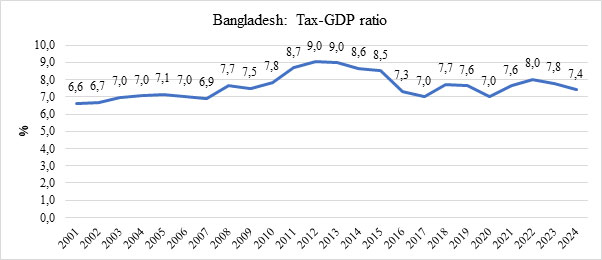
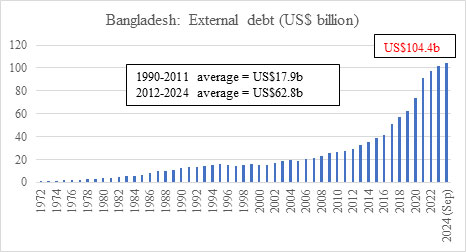
Of course, the other collateral damage is the persistence of corruption. IMF research finds that countries with “voracious” and “fractious” politics divert large amounts of public resources to unproductive transfers to powerful interest groups.
Development partners’ responsible roles
All development partners – multilateral and OECD DAC members – ostensibly are in favour of “good governance”, meaning against corruption. The World Bank “considers corruption a major obstacle… to promoting shared prosperity”. The IMF views corruption as “a major obstacle to economic growth, stability, and development”. The ADB “maintains a zero-tolerance stance against corruption, viewing it as a major obstacle to development, poverty reduction, and economic growth”.
Unfortunately, the evidence of their complicity presented above tells a different story from their avowed anti-corruption posture. This casts doubt on their role as development partners. Global evidence shows that donors do not systematically allocate aid to less corrupt countries.
The citizens of the country expect that development partners remain true to their declared anti-corruption stance and advance concessional loans provided the government commits to strict monitorable anti-corruption measures and deep structural reforms. In particular, urgently needed funds should be considered if:
• Ordinances of the Interim Government designed to strengthen anti-corruption measures, protect human rights and ensure judicial independence are ratified by the Parliament;• amendments to the Bank Resolution Ordinance are repealed; and
• a professionally competent and experienced person with high integrity is appointed as central bank governor.
To achieve deep structural reform, the focus should be on strengthening domestic revenue mobilisation and reorientation away from the aid-dependent development model to a trade and investment led development model. Therefore, development partners should open up their markets, encourage investment in productive sectors and help develop Bangladesh’s productive capacity.
On the other hand, if they remain complicit and advance loans in a highly corruption-prone environment, any future pro-people government will have the right to declare such loans as “odious” and to refuse repayment obligation.
Anis Chowdhury, Emeritus Professor, Western Sydney University (Australia). He held senior UN positions in Bangkok and New York and served as Special Assistant to the Chief Advisor for Finance (with the status and rank of State Minister) in the Professor Yunus-led Interim Government. E-mail: anis.z.chowdhury@gmail.com
IPS UN Bureau