
KABUL, Jun 1 2026 (IPS) - While Afghanistan faces a serious shortage of female doctors, the country’s Islamist regime has placed restrictions on female students from graduating, further exacerbating the situation. Female medical graduates are barred from writing their final exams, which provide them with the professional qualification to practice as medical doctors.
Nilab (name changed) from Afghanistan, graduated as a doctor three years ago from Al-Birun University in Parwan province. She has not been able to practice her profession because the Taliban have banned women from taking the final medical exam.
The final exam is an assessment that aims to measure the competence of medical graduates. It is conducted after seven years of study. Once the exam is passed, the graduate is granted a license to practice medicine. Those who have received the license can also apply for specialization training at teaching hospitals.
“If a doctor does not pass the required final exam, the situation is the same as if they were a student who had just finished high school. When applying for a job at any health center, the first question is: ‘Have you taken the final exam?’ Without it, you cannot work in any hospital, not even as a nurse,” says Nilab.
The final exam was last held for women in 2021. Since then, only men have been allowed to take the exam. The situation is exacerbating Afghanistan’s already dire shortage of female doctors
“I studied for 19 years. Of that time, I lived in a dormitory in another province for seven years, far from my family. It was a difficult time. In the final stage, only one exam, the final exam, has stopped all my progress. Now my future has been taken away from me.”
The final exam was last held for women in 2021. Since then, only men have been allowed to take the exam. The situation is exacerbating Afghanistan’s already dire shortage of female doctors.
Nilab lives with her mother in Kabul, and her family has seven siblings: four girls and three boys.
Two of her sisters and two brothers have also graduated from university, but their futures are uncertain.
Her younger sister scored one of the highest in the national university entrance exam and was accepted to study medicine, but she was unable to complete her studies. Another of Nilab’s brothers graduated in Russian literature but is unemployed.
The family’s only income comes from her mother and one of her siblings, a doctor named Khalida (name changed), who both work as teachers for primary school girls in a public school. With their meager salaries, they shoulder the financial burden of the entire family.
Nilab has tried to earn a living through other means. Until recently, women were allowed to study in non-university health schools.
“Despite all the challenges, I worked as a teacher in a two-year medical school. However, in January 2025, I also lost that opportunity when the Taliban closed medical schools,” Nilab says.
The years of education wasted have caused her a heavy psychological burden, stress and anxiety.
“We have seen how many young women have taken their lives in recent years. Young women’s trust in government, justice and human rights has plummeted to zero. When women’s voices are silenced and they remain imprisoned within us, it becomes unbearable pain. The pain wears us down, it becomes an unhealing wound,” she describes.
The Taliban’s decision has affected all female final-year medical students who completed their studies in 2022 and beyond. There is now a shortage of women in internal medicine, dentistry, surgery, cardiology, and even obstetrics and gynecology.
Khalida graduated from a private medical university in Kabul in 2022.
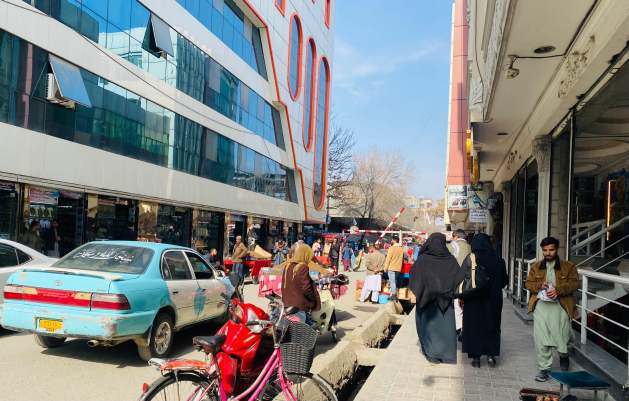
A street in Kabul, where restrictions on women’s education and employment are deepening Afghanistan’s health crisis. Credit: Learning Together.
“Our lives have been completely destroyed by not being able to take the final exam. The future we once dreamed of is gone. We worked hard for this future, which included 12 years of school, a year of preparing for the university entrance exam, and seven years at the university, but all that work has now been lost.”
After graduating, Khalida worked for a while in a few private hospitals without pay to gain experience in the field. At the same time, she specialized in ultrasound examinations. However, the final exam or the exam required for specialization was not organized, and she was eventually forced to stay home.
Sometimes, female doctors are forced to do jobs that are not in line with their training and are very poorly paid.
“I also worked for a while in a hospital distributing nutritional supplements to malnourished patients. However, this is a job that even a high school graduate can do. We are doctors who studied medicine for seven years, and we should serve women in the fields related to our profession.”
Khalida is currently studying English outside of university, hoping to pass the national English proficiency test so that she can get a scholarship and continue her studies abroad. She says that 19 years of studying in Afghanistan have not allowed her to alleviate the suffering of others or herself. She still depends on her family’s financial support. Without it, she fears that she will be forced to stay inside the four walls of her home.
As a result of the Taliban’s numerous restrictions on women, many have lost interest in their own lives. Some have lost faith in marriage, while others have been forced into marriage.
“I am single and have no desire to get married in Afghanistan under the current circumstances. I do not want to allow society to have a new generation that is even more unhappy than my own,” says Khalida.
UN experts have warned that restrictions on women’s education and employment in Afghanistan are deepening the country’s health crisis, particularly by reducing the number of female doctors and other female health professionals who could treat women.
“We female doctors are unable to serve the women of our society despite our years of education. Instead, we have become a burden on our families. There is nothing more difficult for an educated woman than this. We suffer simply because we are women living under Taliban rule,” says Khalida.
Excerpt:
The author is an Afghanistan-based female journalist, trained with Finnish support before the Taliban take-over. Her identity is withheld for security reasons