
NAIROBI, Jun 11 2026 (IPS) - A new report examining the economic impact of oil and gas production in Africa has found that fossil fuels have failed to deliver sustained or inclusive economic development, observing that the resources have contributed to economic vulnerability and inequality and have constrained growth through prohibitive commodity prices, inflation, and weak local currencies.
It reveals that oil- and gas-rich countries were running on economies that are ‘extractive’ in nature, while their other economic sectors remained weak and tended to have elevated levels of corruption, benefiting a few rich, thus perpetuating inequality. This is while delivering few job opportunities, and the sectors employ about 0.3% of the national workforce overall.
The document titled Pipe Dreams, based on evidence from 13 oil- and gas-producing countries, finds that the structure of the oil- and gas-producing economy concentrates on exporting wealth while leaving populations to bear the costs of producing it, ultimately fuelling poverty.
Observing that Africa is in the midst of a “fossil fuel crisis” where global energy prices have surged in the wake of the American-Israeli-Iranian war, exposing countries to expensive petroleum, the analysis by advocacy groups Power Shift Africa and Oil Change International note that producing countries have not been spared the price shocks.
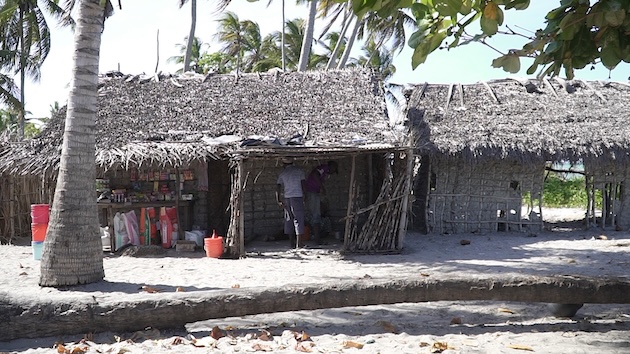
Shanties serving as shops in a village in the natural gas-rich Afungi peninsula of the northern Mozambique region, where poverty remains high. A new report discloses that the government will not receive significant revenues until the mid or late 2030s because contracts allocate most of the early revenues to foreign companies. Photo courtesy of Justica Ambiental
This is because while many of them exported crude, they later imported costlier refined products refined abroad, including petrol and diesel. This happens as hundreds of millions of people across the continent still lack access to electricity and clean cooking energy.
“In some cases, such as Nigeria, Equatorial Guinea, and Mozambique, gas is extracted and exported to serve external markets, while domestic energy needs go unmet,” the analysis explains.
This happens against a backdrop of millions living in extreme poverty, Nigeria and Angola being two such countries where the report acknowledges that an estimated 40% of the population survive on less than USD 3 per day, decades of extracting oil notwithstanding.
“In fact, according to the African Import-Export Bank, Africa’s oil exporters have mostly had lower economic growth and higher inflation than their non-resource-intensive counterparts in recent years,” it explains.
Basing its conclusions on peer-reviewed literature, official data, and independent reports, it asserts that, among others, the fossils sector in Africa is ‘extractive’ in nature, with extraction occurring in ‘enclaves’.
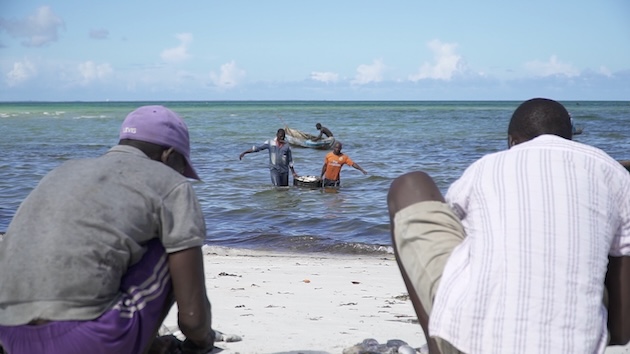
Fishermen at a village in the natural gas-rich Afungi peninsula of the northern Mozambique region, where poverty remains high. The new Pipe Dreams report reveals that the government will not receive significant revenues until the mid or late 2030s because contracts allocate most of the early revenues to foreign companies. Photo courtesy of Justica Ambiental
By breeding an extractive economy where the commodities are mostly exported, the main economic function for producer countries is restricted to generating revenues and export earnings.
This is made worse by the fact that the natural wealth is dominated by multinationals, who often “take a disproportionate share of the revenues either through one-sided contractual terms or through lopsided accounting schemes”.
Citing the example of Mozambique’s Coral South gas project led by Italy’s Eni, which began producing gas in 2023, it discloses that the government will not receive significant revenues until the mid- or late-2030s. The reason is that the contract terms usually allocate most of the “early revenues” to foreign companies to the exclusion of governments.
The report faults fossil sectors for having few links to other sectors in an economy, noting that related sectors, including services and supplies, are “generally imported, while the products and the profits are mostly exported”.
Released on 11 May to coincide with the Africa Forward 2026 summit sponsored by France and bringing together more than 40 African presidents and heads of government in Nairobi, Kenya, it asserts the fossil wealth was creating minimal employment opportunities, even when it constituted a large share of gross domestic product (GDP).
“The enclave effect is especially strong with floating offshore facilities, as companies can tow these facilities into place and load oil and gas onto tankers without ever setting foot in a country”,
For example, in Nigeria and Congo Brazzaville, the oil industry employs only 0.01% of the countries’ workforce and 0.3% in Angola, the document reveals.
Even worse, the extractive economy tended to harm other economic sectors, worsening poverty, a good example being the west African country suffering frequent oil spills that negatively impacted agriculture and food security.
Almost all African oil producers have suffered corruption scandals related to their oil and gas revenues, and between 1989 and 1993, senior executives of French company Elf, now part of TotalEnergies, allegedly paid bribes to politicians in Gabon, Angola, Cameroon and Congo-Brazzaville in a USD350 million scandal.
In other instances, the fossils are exposed and vulnerable to the dynamics of international markets, leaving countries heavily indebted during oil price collapses, a good example being 2014 when oil prices crashed, forcing Angola to cut its budget by 25%, with public employees and suppliers going unpaid for months.
The report makes a strong case for accelerated adoption of renewable energy across Africa as a more just and inclusive alternative, explaining that fossils are not a “viable foundation for equitable economic development”.
What Africa needs now is a green and more resilient energy system and rich countries should support the continent financially and technologically for the transition to happen, said Power Shift African head Mohamed Adow.
“What we need right now is an energy future built around people, not exports, because it is obvious that we cannot drill ourselves out of poverty,” he said.
It was a shame that as many as 600 million people had no access to electricity and around 900 million lacked clean cooking energy despite the abundance of renewable resources such as solar all over Africa, he said.
“It is also sad that African countries are locked up in fossil dependency while big countries like China are exporting technologies. Our presidents see oil and gas as shortcuts to wealth. We must adopt development that genuinely serves the people,” he told a media briefing on the report in Nairobi.
“Real prosperity” for Africa, he noted, will come from investing in renewables while ending the tradition of using the limited forex available to “import problems”, in the form of finished petroleum products.
For this reason, international facilities such as climate finance must be made to work and help prove that development and climate action can go together. “It is our duty to help challenge the notion that there is no development without fossils,” he added.
The continent must therefore adopt a development model that serves its people, rather than one that benefits external actors, including for key services such as finance and insurance, all of which take place overseas.
Extracting and shipping resources out of Africa amounted to shipping out value, including jobs, according to Amos Wemanya, Power Shift Africa’s Senior Advisor, Renewable Energy and Just Transition.
The notion that renewables cannot power development across the continent has been debunked, and what is needed is continued scaling up of tested and proven renewable models of development.
“The oil and gas era has failed our continent and the energy revolution is happening on our rooftops, not in the oilfields,” he stated in reference to growing uptake of solar for powering homes and institutions across Africa.
Currently the global financial system has left many countries in distress, with nearly 57% of the African population, or about 751 million people, living in countries that spend more on interest payments than on health and education, according to UN Trade and Development (UNCTAD).
This has resulted in calls for debt restructuring and a review of credit ratings. Wemanya added, “Building resilience in African economies needs a fair international financial system.”
IPS UN Bureau Report