
BONN, Jun 19 2026 (IPS) - The United Nations June Climate Meetings (SB64) ended in Bonn with sharp disagreements between developed and developing countries over climate finance, adaptation support and emissions reductions, leaving negotiators with significant unresolved issues ahead of the COP31 climate summit in Antalya, Türkiye.
After nearly two weeks of negotiations at the World Conference Center Bonn, delegates acknowledged some progress on technical matters such as technology transfer, capacity building and just transition discussions. However, many of the most politically sensitive issues, particularly adaptation finance and implementation support for developing countries, remained unresolved.
UNFCCC Executive Secretary Simon Stiell described the atmosphere as increasingly difficult, warning against what he called a tendency among countries to wait for others to act first.
“In some negotiating rooms, we’ve heard a familiar tendency towards ‘you-first-ism’ — groups refusing to deliver commitments or allow the process to move forward unless others go first. This is a recipe for gridlock when we need all negotiating tracks to be moving in the fast lane,” Stiell said in his closing assessment.
The Bonn meetings serve as a key preparatory stage for annual UN climate summits. The discussions are intended to advance technical negotiations and lay the groundwork for political decisions at the next Conference of the Parties. This year, however, the meetings exposed deep divisions over who should pay for climate action and how quickly countries should reduce emissions.
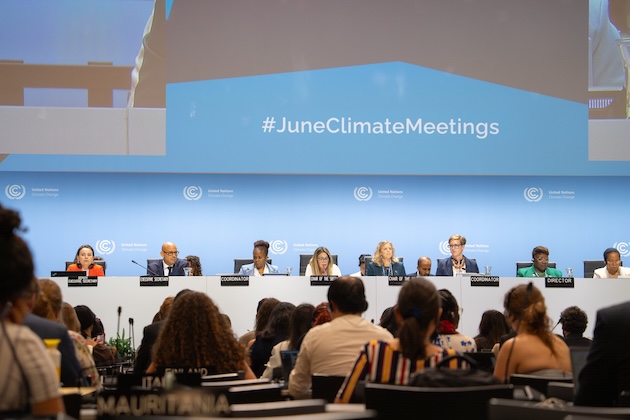
Climate negotiators in Bonn. Credit: UN Climate Change/Lara Murillo
Developing countries argued that adaptation remains an urgent priority because millions of people are already suffering from climate-related disasters. They stressed that without substantial financial support, adaptation plans cannot be implemented effectively.
Speaking on behalf of the Group of 77 and China, Uruguay said developing countries remained deeply concerned about the lack of progress on adaptation and adaptation finance.
“Adaptation remains a key priority for developing countries,” the group said, stating that there is a need to move forward in ways that address the growing adaptation needs of vulnerable nations.
The G77 and China also called for greater attention to climate finance commitments under Article 9.1 of the Paris Agreement and stressed the importance of turning discussions into practical action.
“We should move beyond dialogues and reports and translate into effective implementation of climate action,” the group said, noting that agriculture, livelihoods and food security in developing countries are already being affected by climate change.
The European Union acknowledged that some progress had been achieved but said the pace of negotiations remained too slow.
“The pace remains insufficient to meet the scale of the challenge before us,” the EU said in its closing statement. The bloc urged countries to focus on implementing previous climate agreements and reaffirmed support for limiting global warming to 1.5 degrees Celsius above pre-industrial levels.
The EU also expressed frustration over the handling of adaptation negotiations.
“We are extremely disappointed in how GGA negotiations have been handled here in Bonn,” the bloc said, while calling for discussions to continue at a higher political level ahead of COP31.
Several negotiating groups voiced concern over attempts to challenge or weaken scientific findings that underpin international climate action.
The Environmental Integrity Group, represented by Switzerland, warned against efforts to undermine the role of science.
“Science is not negotiable,” the group declared, urging countries to support the timely publication of future reports by the Intergovernmental Panel on Climate Change (IPCC).
The group said scientific evidence had consistently guided global climate action and should remain central to future decisions, including the second Global Stocktake process under the Paris Agreement.
The Umbrella Group, represented by the United Kingdom, echoed similar concerns.
“Our climate action must always be guided by the best available science,” the group said. It expressed disappointment that negotiators were unable to reach more substantial conclusions on research and systematic observation.
The Alliance of Small Island States (AOSIS), representing some of the world’s most climate-vulnerable countries, delivered one of the strongest critiques of the Bonn outcome.
The group said it was disappointed by the pace, tone and approach of the negotiations and warned that insufficient progress had been made to ensure a successful COP31.
“AOSIS is deeply concerned by the attempts that were made across agenda items to place the 1.5 limit in doubt, to overlook and diminish its significance as a lifeline for SIDS,” the group said.
Small island nations face existential threats from sea-level rise, coastal erosion and increasingly severe storms.
AOSIS also criticised the slow progress on adaptation finance and transparency issues, saying procedural obstacles had prevented meaningful advances.
The African Group of Negotiators similarly expressed frustration over the lack of movement on climate finance.
Speaking on behalf of 54 African countries and more than 1.6 billion people, Ghana warned that Africa could not afford delays as climate impacts intensify across the continent.
“Antalya and Addis Ababa must deliver meaningful progress as a solid foundation for GST2,” the group said, referring to the second Global Stocktake process.
African negotiators argued that disputes over governance and terminology should not delay efforts to provide desperately needed adaptation finance for vulnerable communities.
The BASIC group, which includes Brazil, South Africa, India and China, also highlighted concerns over declining support for developing countries.
The group called for climate finance to occupy a central place at COP31 and urged countries to complete the transition of the Adaptation Fund so that it can better support vulnerable nations.
BASIC further stressed that developed countries must take the lead in reducing emissions while also mobilising financial support for developing nations.
The Least Developed Countries (LDC) Group delivered an emotional message, saying vulnerable populations were running out of time.
“LDCs do not look to this process for promises, but for action,” Timor-Leste said on behalf of the 44 least developed countries. “Our people didn’t send us here to negotiate the terms of their suffering.”
The group warned that climate impacts are accelerating faster than international responses.
“We reject the blatant undermining of science at this session,” the LDCs said. “Science is neither contentious nor negotiable for our group.”
The Mountain Group, representing 11 mountainous countries, focused attention on the growing vulnerability of mountain regions. Kyrgyzstan said mountain communities are facing severe challenges from glacier loss, water shortages, floods and ecosystem degradation.
The group welcomed the first formal Dialogue on Mountains and Climate Change and called for mountain issues to become a permanent part of the UN climate process.
Meanwhile, the Like-Minded Developing Countries (LMDCs), represented by China, emphasised equity and the principle of common but differentiated responsibilities as essential foundations for climate cooperation. The group argued that implementation gaps often arise because promised support from developed countries fails to materialise.
Outside the negotiating rooms, civil society organisations sharply criticised the outcome.
Oxfam accused wealthy countries of avoiding their responsibilities on climate finance.
“The UN negotiations have once again been derailed by rich countries’ refusal to take responsibility for increasing critical public climate finance,” said Mariana Paoli, Oxfam’s Climate Policy Lead.
According to Oxfam, even if the pledge to triple adaptation finance were fully implemented, it would provide about $120 billion, far below the estimated adaptation needs of developing countries, which are projected to reach between $310 billion and $365 billion annually by 2035.
Paoli described the situation as a “dark irony,” noting that the world’s first trillionaire emerged at a time when vulnerable countries were struggling to secure adequate climate finance.
“The unwillingness of rich countries to engage meaningfully is astonishing,” she said.
Despite the tensions, negotiators did achieve some notable progress.
Countries agreed on the selection of the United Nations Environment Programme (UNEP) as the new host of the Climate Technology Centre and Network, a key institution supporting technology transfer and climate solutions in developing countries. Several groups welcomed the decision as an important step toward strengthening climate action.
Delegates also reported progress on capacity-building initiatives and discussions surrounding a just transition, which aims to ensure that workers and communities are protected during the shift toward low-carbon economies.
IPS UN Bureau Report