
UNITED NATIONS, Jun 22 2026 (IPS) - A record number of children were subject to grave violations by parties to armed conflicts, the highest since the UN mandate for children and armed conflict (CAAC) was established in 1996.
In the Secretary-General’s annual report, UN-verified sources confirmed 35,558 violations committed against children during armed conflicts. This is the fourth year in a row that incidents have increased from years.
The data in the report is based on instances occurring in and verified in 2025. At least 24,174 children were directly affected or had their rights violated, through killing and maiming, forced recruitment, abduction, sexual violence, and denial of humanitarian assistance. At least 1 in 3 victims were girls. The killing of children increased by 34 percent compared to incidents from 2024, totaling to 14,224 children killed or maimed. 5129 children were abducted, and there were at least 8322 instances of denial of humanitarian assistance. 6607 children were recruited or used by armed groups, and a total of 1667 children were detained for their actual or alleged connection to armed groups.
For the first time since the CAAC mandate was created, government forces were responsible for the highest number of grave violations. In addition to the killing and maiming of children, government forces were largely responsible for the destruction or military use of schools and hospitals, and the denial of humanitarian access. This sense of impunity is further amplified by hostilities, and in the increasing use of wide-area explosive weapons and in densely populated areas, resulting in more civilian casualties. The use of artificial intelligence and autonomous weapons systems has also transformed.
The states responsible for the highest number of violations included Israel, the occupied Palestinian territories, Myanmar, Somalia, Nigeria and the Democratic Republic of the Congo (DRC). Israeli forces were responsible for nearly one-third of the grave violations in the report — 12,455. In the DRC, 4,114 grave violations against children were committed, including 519 deaths and 1067 abductions.
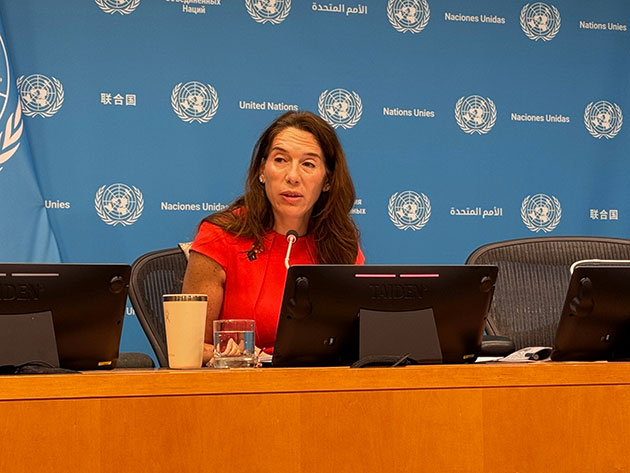
Vanessa Frazier, the UN Secretary-General’s Special Representative for Children and Armed Conflict, at the release of the Secretary-General’s annual report on children and armed conflict in 2025. Credit: IPS / Naureen Hossain
Under-Secretary-General Vanessa Frazier, the Special Representative for Children and Armed Conflict, warned that the frequency — and intensity — of violations against children reflect a growing disdain for international law and the protected rights of children.
“2025 was without a doubt one of the darkest chapters for child protection since monitoring began,” said Frazier. “When States, on whom the obligation to protect children falls, instead contribute to their suffering, it signals the deeper erosion of respect for international law. The principles of humanity, distinction, proportionality, and necessity must be restored — without exception.”
Frazier told reporters on June 18 that the report and its findings is meant to be a “tool of accountability”. It should be used by member states to take the appropriate steps to protecting children in armed conflict. In the case countries named in the report with ongoing situations, this is also an opportunity for them to enter into agreements to reduce and prevent further violations during conflict between now and the following year.
Frazier confirmed that early drafts of the report were shared with these countries back in March, and the countries had at least one month to present their own evidence to be corroborated with the UN-verified data. She added that open dialogue between her office and the countries is encouraged, if those countries choose to engage in the first place.
The report calls on member states to uphold international law to protect civilians, especially children, during times of conflict, through upholding their commitments to existing peace and security agreements. Parties to conflicts are also called on to develop and implement action plans with the UN, and to grant the UN access to conduct thorough monitoring and reporting of grave violations against children.
The report also calls on technology and social media companies to take concrete measures to prevent their platforms from being used by armed groups to recruit and exploit children, and to cooperate with accountability and child protection mechanisms. The misuse of digital technology can have adverse effects on children’s wellbeing even in peaceful contexts. Without sufficient legal guardrails and proper monitoring, children are more likely to be exposed to misinformation and recruitment content.
A senior UN official told Inter Press Service that online recruitment is a pervasive issue across multiple conflict areas, and that more resources need to be mobilized to create responsibility. The official confirmed that Frazier and her office were in contact with lawmakers from the European Union to determine how existing frameworks like the Digital Services Act could protect children. The office is also working with TikTok in Colombia to implement strategies to prevent the recruitment and use of children during conflict.
Frazier called on the state actors to adopt action plans to protect and reintegrate children formerly associated with armed groups. In 2025, 13,112 children received protection and reintegration support with the help of other UN agencies like UNICEF and its partners. This requires funding support from donors and state parties as much as it requires political will. Further investments into accountability and prevention measures among parties in conflicts are also needed, through partnerships with the UN, governments and parties to conflicts.
Before she was the Secretary-General’s Special Representative (SRSG) for Children and Armed Conflict, Frazier was the Permanent Representative of Malta to the UN during its term in the Security Council from 2023-2024. Both in her capacity as SRSG and as a member of the Security Council, Frazier has visited conflict sites and spoken with children directly impacted. She reflected that it was particularly aggravating to see state actors in the list of perpetrators in the report, given that state actors, who are also UN member states, are supposed to be the ones abiding by the rule of law and protecting children. “It’s not acceptable that there are nine state actors listed, irrespective of who they are and how bad they are,” said Frazier.
What was most striking to her is that many of these incidents that resulted in so many child casualties could have been avoided. State actors seem to make the conscious, operational decision to target factories manufacturing weapons or enemy strongholds, regardless of whether civilian infrastructures like schools are nearby and would get caught in the radius. Even if those infrastructures are not the intended target, state actors will follow through with the attacks, which show a disregard for international humanitarian law and a lack of concern for the consequences of civilian casualties. It is children who are suffering the consequences of state actors’ decisions, Frazier said.
“I think for state actors it is worse than non-state actors, because this mandate was originally created to target armed groups and non-state actors; ones who work outside of the law. We cannot have state actors who are supposed to work within the reams of the law, now working outside the reams of the law. That should not be something that is acceptable.”
IPS UN Bureau Report