
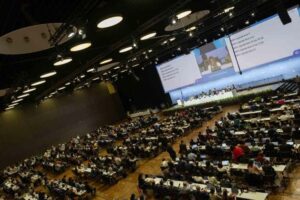
APEX, North Carolina / SAN FRANCISCO, California, Jun 30 2026 (IPS) - With progress stalled on many issues, this year’s June talks in Bonn—which are supposed to smooth the way towards COP 31 in Antalya at year’s end—were widely judged a failure. What happened? And what does it mean for Antalya?
“Deliberately delaying us.”
“Spreading misinformation.”
“Denying the science.”
“Lacking integrity.”
“Blocking progress.”
“Costing countless lives.”
These were just some of the charges delegates leveled at each other during the UN Climate Meetings held in Bonn this June. As delegates took up multiple issues in small “contact groups” and “informal consultations”, negotiations quickly became tetchy and irritable before descending into levels of rancor and even rudeness rarely seen before. And it was not just one issue where tempers frayed.
What went wrong? One problem is the sheer number of topics on the Bonn agenda. Over the thirty-plus years since the UN climate talks began, countries have been keen to add issues they particularly care about to the agenda
From talks on climate change research and science to topics like mitigation and funding for adaptation, the mood was often combative and confrontational. By the meeting’s end, differences were so great that in many cases delegates could not even agree to continue working on the draft outcome documents from Bonn when they arrive at COP 31 in Antalya later this year.
This means they will need to start discussions from scratch. In other cases, they failed to finish their work, but at least managed to forward the current working texts. This is hardly a great outcome, however.
In fact, Bonn may have witnessed more arguments over “mandates” (whether a particular group should be discussing certain topics) and “points of order” (whether delegates were playing within the rules) than ever before in the climate change process.
Searching for positives, some participants pointed to one success. Delegates did choose the UN Environment Programme (UNEP) to host the Climate Technology Centre (CTC).
The CTC provides technological support to developing countries. It means the Centre’s work will continue beyond 2027 and possibly all the way through to 2041. But even the glow of this minor “win” dims when one recalls that UNEP was already the host.
This agreement simply means it can carry on its work. It doesn’t create something new. When continuing to do something that’s already happening counts as a victory, you know things haven’t gone well.
Too Many TopicsWhat went wrong? One problem is the sheer number of topics on the Bonn agenda. Over the thirty-plus years since the UN climate talks began, countries have been keen to add issues they particularly care about to the agenda.
For instance, vulnerable small island nations are eager to talk about keeping global warming under 1.5oC, the threshold at which scientists fear serious “tipping points” will be reached. They also want to talk about phasing out fossil fuels—the major cause of climate change—and about wealthy countries helping them to adapt.
Meanwhile, fossil fuel exporters like Saudi Arabia are keen to talk about what wealthy western nations’ actions, including carbon taxes or a shift to renewables, are doing to their oil-based economies. They believe these “response measures” could harm them—or already are. That said, these same oil and gas-rich nations certainly do not want to talk about getting rid of fossil fuels.
A third example are the western nations, particularly those in Europe, who are making efforts to shake off their dependence on oil and gas.
They are happy to talk about renewable energy and science, but are keen to shut down talk about funding or compensating countries affected by what the Europeans consider to be their virtuous efforts to change. Bailing out oil producers for any “harm” done to their export trade is the last thing on their minds.
As the various groups have added their topics to the negotiations over the years, these divergent views have collided with ever greater force. Although there are frequent calls to simplify the process, no country is going to give up their “pet” topic, especially since that would mean more time to talk about someone else’s favorite issue. Could everyone agree to simplify and give up their preferred agenda item? Maybe. But so far, no one has blinked.
The Rule Is, There Are No Rules!Making things more difficult still are the UN climate treaty’s “rules of procedure.” These were developed in the 1990s when countries first penned the UN Framework Convention on Climate Change—the bedrock agreement on which the Kyoto Protocol and Paris Agreement were also built.
The rules of procedure offer a way out of difficult issues by allowing for countries to vote. In some cases, a two-thirds majority is required to “win” on an issue. Sometimes, the bar is even higher and a three-quarters majority is needed.
The trouble is, these rules were never formally adopted. Saudi Arabia and a number of other countries refused to agree to them. What this means is that consensus is required for everything. So, what happens when a treaty has 198 parties, all with differing views and priorities on what is possibly the most complex issue of our times? One could argue it’s a miracle anything has been agreed at all.
The COP 31 PileupWhat does this mess mean for COP 31, which is taking place in Antalya, Türkiye, in November? First, it means an agenda pileup. The annual June climate meeting in Bonn is supposed to help pave the way to the end-of-year COP. Bonn’s job is to resolve much of the low-hanging fruit—agenda items that require some sort of agreement or outcome document, but which can be taken care of relatively quickly. This then leaves the COP to finish up work on the big, meaty, difficult issues.
The problem is, Bonn resolved almost nothing. Even the low-hanging fruit seems to have soured. With so many documents unresolved and “rolled over” (or, in the jargon of the process, ‘Rule 16ed’), COP 31 will have a massive workload. It’s a logjam that seems unlikely to be cleared in Antalya.
Does this mean COP 31 will fail? Not necessarily. One silver lining that could be observed in Bonn was how well the two countries presiding over COP 31 seemed to be working together. In an unusual arrangement, the government of Türkiye is physically hosting and organizing the COP, while the government of Australia is joining as co-president tasked with handling the diplomatic negotiations.
Their collaborative spirit and air of quiet competence provided a ray of hope in Bonn. Also, there are two pre-COP events in October—one taking place in Fiji, the other in Tuvalu—that might help.
Still, the signs are not good overall.
Fixing the ProcessBonn did not occur in a vacuum. By common consent, the UN climate process has been getting steadily more complicated by the year, especially since the Paris Agreement was inked back in 2015. Bonn was just the latest example—and one of the more extreme—in how confusing and difficult it has become from an agenda perspective.
There is also a growing interest in these negotiations to reckon with. Some of the early COPs attracted only a few thousand participants, while today the numbers regularly top 50,000 and more.
The most extreme, COP 28, topped 83,000! Some argue this is making it more difficult, while others see this as a positive development, since it demonstrates to politicians that climate change remains a critical issue. Either way, this evolution adds to the organizational complexity of the process.
These recent travails and complications have led to a steady stream of think pieces, reports, and meetings aimed at streamlining, simplifying and improving the system. They contain many good ideas for shedding agenda items and other alterations.
Perhaps one day frustration will mount to a point where some of these good ideas actually happen. But with countries so divided on the substance of the talks, it is hard to imagine them agreeing on their organization, at least in the short term.
Does It Really Matter?In spite of the mess the process is in right now, we can see four reasons to remain positive and not to give up hope.
First, COP 31 is not a “make or break” COP. Sure, it needs to keep the momentum going. But there are no major outcomes needed in Antalya.
Instead, delegates and observers are looking more to COP 32 in 2027—which will review countries’ success in implementing their pledges under the Paris Agreement—and COP 33, which is tasked with completing a second “global stocktake” of progress. COP 33, in particular, will need to end with something noteworthy. Interestingly, COP 33 is also likely to take place hard-on-the-heels of the U.S. Presidential elections.
Looking further out, COP 35 in 2030 should mark another important moment in the process, with countries scheduled to submit their next set of pledges or “Nationally Determined Contributions”.
A second reason to stay positive—and no disrespect to the climate negotiations—is that we already have in place the major agreements we need to make progress.
The UN Framework Convention on Climate Change and the Paris Agreement are the launch pads we need. A lot of the negotiations occurring these days in Bonn and at the COPs are relatively minor and procedural. Now, our work can and should be more about implementing what we’ve agreed.
To be clear: the COPs have an important role to play in reviewing progress and encouraging countries to do more. But the foundations are already in place, the promises made. Now, it is about doing what we have said we would.
Thirdly, the creation of “Coalitions of the Willing” in recent years show there is an appetite for promoting implementation even on issues where there is not yet consensus among all 198 member states.
Alliances designed to advance progress on critical matters such as energy, agriculture, water, oceans, and health can only help us move forward. While some, such as the Glasgow Financial Alliance for Net Zero (GFANZ), have failed in their original goals, the potential is certainly there.
The recent alliance to transition away from fossil fuels, and another initiative on financing known as the “Vulnerability to Viability Compact”, are positive developments that could and should help us on the path to implementation.
Are we doing what is needed? Not yet. At least, not fast enough. But—and this is our fourth and final note of positivity—there is hope here. It’s worth noting that, since the Paris Agreement in 2015, the trajectory of global warming has changed. Back in 2015, the world was staring down the barrel of 4-6oC in warming by the end of this century. These numbers should cause any sensible person to quail. They are extinction-level predictions; apocalyptic in their scope, horrifying in their impact.
Today, the numbers have fallen to between about 2.1oC and 2.8oC, depending on your assumptions. These numbers are still very, very bad. They threaten breaching all sorts limits, passing many points of no return.
Even at 1.5oC warming, we are seeing unprecedented weather such as the heatwaves felt recently in Europe. Still, we have started to bend the curve. As a result of government policies, scientific breakthroughs, private sector initiatives and action from many, many stakeholders, things are slowly beginning to change.
Our friend Christiana Figueres, who played a major role in the Paris Agreement, talks often about “stubborn optimism”. We agree. This is the time to double down on climate action. With renewed energy and dogged persistence, we can keep bending the curve and change humanity’s future.
This, surely, is something participants at future COPs should be striving towards.
Prof. Felix Dodds and Chris Spence have participated in United Nations talks on climate change and other environmental negotiations since the 1990s. They co-edited Heroes of Environmental Diplomacy: Profiles in Courage (Routledge, 2022) and wrote Environmental Lobbying at the United Nations: A Guide to Protecting Our Planet (Routledge, 2025). Their next book, Political Heroes of the Environment: Profiles in Courage, is due for release in 2027.