
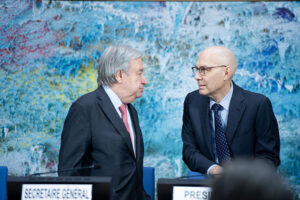
UNITED NATIONS, Jul 3 2026 (IPS) - While the movement for the universal abolition of the death penalty advances, this progress “cannot be taken for granted,” said UN Secretary-General António Guterres as he greeted the 9th World Congress Against the Death Penalty.
In his video message, Mr. Guterres said, “the death penalty does not deliver justice. It is an inhumane form of punishment. It puts innocent lives at risk. And it has no place in the 21st century.” Worldwide, the push for abolition has gained momentum, with the Secretary-General reaffirming the UN’s full commitment to universal abolition “firmly and without exception.”
The 9th World Congress Against the Death Penalty, taking place in Paris between June 30th and July 2, 2026, convenes governments, UN officials, legal professionals, journalists, and activists to discuss concrete steps to reform and ultimately abolish the death penalty. The Congress is organised by ECPM (Together Against the Death Penalty), a leading French NGO that began campaigning for universal abolition in 2000 and has organised all 9 World Congresses Against the Death Penalty. The Congress is sponsored by France, and the European Union and Switzerland are co-sponsors.
At the opening of the 9th World Congress Against the Death Penalty, the UN Human Rights Commissioner, Volker Türk, further underscored the UN’s staunch position on universal abolition. In his opening remarks, Volker Türk urged “all States, everywhere, to join the overwhelming, and principled, global consensus that use of the death penalty must end, everywhere, for all offenses.”
France’s president, Emmanuel Macron, mirrored Mr. Türk’s remarks, speaking at the Congress to the fact that “the death penalty has never made a society safer.”
“Never, because it does not act as a deterrent. It’s crazy. It has been demonstrated, observed and measured. The death penalty has never had the deterrent effect that certain, often authoritarian, authorities who defend it would like to attribute to it,” said Macron.
Prior to the start of the Congress, the European Union (EU) put forth a statement to the UN Human Rights Council on June 18, highlighting how capital punishment is a discriminatory practice that violates the inalienable right to life. The statement stressed how the death penalty is incompatible with human dignity and called for a moratorium by states as the first step towards abolition.
The EU Statement reiterates the key points from a May 21st statement from 41 Members of the Inter-Regional Task Force on the Moratorium on the use of the Death Penalty. While more than two-thirds of UN member states have abolished the death penalty in law or in practice, there has been a recent and significant increase in executions among the few retentionist states. The signatories of the statement emphasized how the 9th World Congress Against the Death Penalty represents an immense opportunity to reaffirm the global commitment to universal abolition.
Within the retentionist states, recent data from the Office of the High Commissioner for Human Rights (OHCHR) highlights an alarming spike in capital punishment. These increases were due to executions for drug-related violations for crimes that people committed as children and offences that did not meet the ‘most serious crimes’ criteria. Examples of actions by retentionist states include Iran, with over 1,500 individuals executed in 2025, 47 percent of which related to drug offences. Israel, which has set forth a series of legislative proposals introducing mandatory capital punishment provisions that would apply only to Palestinians. Other countries, including the United States, Somalia and Singapore, have also seen increases in executions.
While these numbers are startling, there has been immense progress towards abolition. 170 countries have either abolished or introduced a moratorium on the death penalty in law and/or in practice. Some states that have not yet fully abolished the death penalty but have taken encouraging steps to limit capital punishment include Vietnam, Pakistan, Zimbabwe, Kenya, Malaysia, and Kyrgyzstan.
These trends confirm that abolition is a core testament of the international community’s commitment to human rights and upholding international law. The International Covenant on Civil and Political Rights, which has been ratified by 175 states, guarantees the “inherent right to life” and that the death penalty may “be imposed only for the most serious crimes in accordance with the law” for the countries that have not yet abolished it. The 9th World Congress Against the Death Penalty presents an opportunity to take concrete steps towards the path of abolition, with the full support of the UN and Secretary-General António Guterres behind the Congress.
IPS UN Bureau Report