

SYDNEY, Australia, Jul 28 2026 (IPS) - As Western Europe endured its worst-ever June heatwave in recorded history, the imperative for climate adaptation is now urgent as the continent accelerates beyond others to become the fastest-warming region in the world.
In May temperatures began increasing to levels previously not experienced until mid-summer in July, and the impacts on human health and social inequalities are now evident. Experts emphasise that the warnings are clear about the future under worsening climate extremes.
“The heatwaves that affected western Europe in May and June were unusual because of their intensity and their early timing,” Julien Nicolas, senior scientist at Europe’s Copernicus Climate Change Service, told IPS.
Yet “the weather patterns behind the recent heatwaves, characterised by persistent high pressure over the region and hot air drawn from North Africa into western Europe, have been observed in many previous European heatwaves. Studies have also shown that the number of summer heatwaves has risen particularly sharply in Europe compared with other continental regions.”
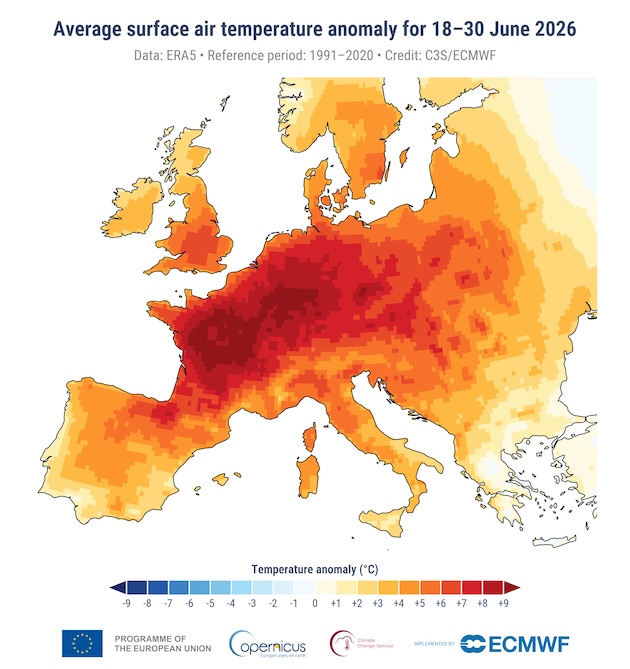
Europe’s Copernicus Climate Change Service reports the average anomalies in air temperatures in Europe during this year’s heatwave from 18-30 June 2026 relative to the average temperature for the 1991-2020 reference period. Cedit: C3S/ECMWF
By late June, the record temperature of 41.7 degrees Celsius was reached in eastern Germany, 40 degrees in Vienna, Austria, and 43.8 degrees in western France, reports the World Meteorological Organization (WMO). While western Europe has borne the worst so far, heatwave conditions now extend across central and eastern Europe. In Romania, located south of Ukraine and west of Hungary, temperatures rose dramatically in early July to exceed 35 to 40 degrees Celsius, Daniel Modoacă, Head of Emergency and Disaster Response at the Romanian Red Cross in Bucharest, told IPS.
France and Spain are also at the centre of a wildfire crisis, fuelled by successive heatwaves that have forced the evacuation of more than 300,000 people. The current emergency has been described by French President Emmanuel Macron as the country’s worst fire-related crisis since World War II.
The record-breaking European summer is consistent with the region warming at twice the global average since the 1980s. The continent’s worst heatwaves have all occurred since 2020, and now one consequence is that ‘Europe faces a growing risk of megadroughts that span large regions and last for several years,’ reports the European Environment Agency (EEA).
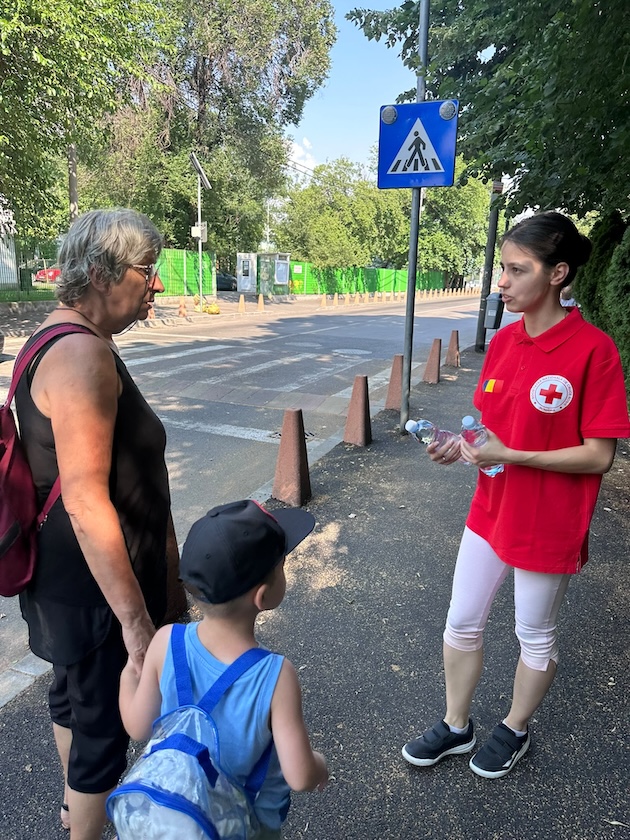
Following a red alert issued for extreme temperatures, Romanian Red Cross volunteers in Bucharest’s Sector 4 distributed drinking water and supported the health and safety of local communities. Bucharest, Romania. Credit: Romanian Red Cross-Bucharest Sector 4
Yet it is not just heatwaves. Europe has also endured excessive rainfall in recent years. Life-threatening floods following major storms occurred in Valencia, Spain, in late 2024. They caused more than 200 deaths, and the devastation ranged from landslides to damage to housing, power, transportation and road infrastructure. In the same year, severe floods also affected Austria, Poland, Czechia and Romania.
But as Europe approaches midsummer, people are facing immediate shocks to their health and wellbeing.
“In Bucharest, the combination of extreme temperatures, dense urban infrastructure and limited nighttime cooling has intensified the impact on vulnerable groups, particularly the elderly, people with chronic illnesses and households facing financial hardship,” Modoacă said, with the interior cooling of homes a major challenge for 17.7 percent of Romanian households already struggling to pay electricity bills.
But the Romanian Red Cross is striving to meet people’s needs by providing drinking water, basic health monitoring, including blood pressure checks, and assistance for those living with medical conditions likely to be worsened by extreme heat. As well as “support for the homeless, who are among the most exposed during prolonged heatwaves, and assistance for rural households, where access to cooling systems and medical services are limited”, Modoacă added.
When high air temperatures are relentless for long periods, and higher than average night temperatures don’t offer relief, the human body is subjected to stress that can diminish its ability to function, leading to heightened risks of heat exhaustion, heat stroke, the worsening of existing illnesses, such as cardiovascular disease, and, in the worst scenario, loss of life.
This year more than 150 million people in European countries have suffered from the heatwave, with 10,000 extra related deaths in late June, according to health authorities. Meanwhile, the WHO reports that heat-related mortality in Europe has risen by 30 percent during the past 20 years, with an estimated 175,000 related fatalities per year. While the same mortality rate for people over the age of 65 years increased by 85 percent from 2000 to 2004 to 2017 to 2021.
In cities, where the built environment has retained the heat to intense levels, health and humanitarian services have been stretched and overwhelmed. In Paris, hospital and ambulance services have been under severe strain, while the French Red Cross has extended its humanitarian outreach to the public with emergency round-the-clock cooling shelters where people can access food, drinking water, sleeping facilities and social support.
However, the longer-term repercussions of climate warming were revealed in new research published in the Global Environmental Change journal. Scientists in Germany claim that severe heatwaves in Europe have widened the inequality gap, significantly impacting lower-income households the greatest and pushing an extra 5.6 million people into risk of poverty on average from 2004 to 2022.
Last month, Mary Friel, the Climate Policy Senior Officer at the International Federation of the Red Cross (IFRC), declared that ‘extreme heat is now one of the defining humanitarian challenges of our time, a major public health risk that demands action from people, institutions and governments alike.’
It was a message reinforced In July by WHO Regional Director for Europe, Hans Kluge, who told the media that most European countries were not prepared for the health repercussions of future heatwaves, including the heatproofing of health infrastructure. ‘Heatwaves can overwhelm hospitals that may not be designed to cope with higher temperatures, especially as admissions rise. Hospital buildings can overheat, causing power supplies and cooling systems, as well as computers and tech services, to fail,’ warns the WHO. Some of the challenges to implementing climate adaptation in the region include limited resources, insufficient dedicated finance and lack of private sector and citizen engagement, claims the IPCC.
Yet the European Union (EU) has demonstrated a commitment to climate action with an ambitious goal of achieving net zero greenhouse gas emissions by 2050. Meanwhile, the European Green Deal, which was launched in 2019, sets out a plan to accelerate the region’s transition to clean infrastructure, energy, transport and industries. And last year Copernicus reported that 46.4 percent of all electricity produced in Europe derived from renewables.
At the same time, the current crisis in Europe has worldwide implications, as the global temperature rise is now estimated to be 1.4 degrees Celsius above pre-industrial levels. And, with current trends, the safety threshold of 1.5 degrees Celsius could be reached by the end of the decade. Nicolas told IPS that every additional fraction of a degree above 1.5 degrees Celsius would increase climate threats to ecosystems, water and food security, infrastructure and the economy and “the possibility of parts of the climate system reaching tipping points”.
IPS UN Bureau Report