
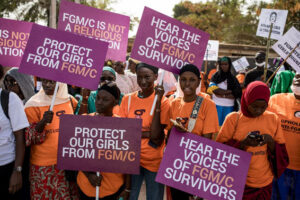
MONTEVIDEO, Uruguay, Aug 3 2026 (IPS) - Last August, a one-month-old girl in The Gambia bled to death after being subjected to female genital mutilation (FGM), a practice that had been illegal in the country since 2015. FGM is a human rights violation, whatever the appeals to faith or tradition made in its defence, but now the Gambian Supreme Court is being asked to strike the country’s ban down. This is the second attempt in two years to make FGM legal again.
Civil society stopped it the first time. When a repeal bill reached the National Assembly in 2024, the Network Against Gender-Based Violence brought survivors to testify, lobbied legislators, ran radio programmes and obtained a ruling from Cairo’s Al-Azhar University saying that FGM is not required under Islam. The bill fell in July 2024.
The ongoing fight in The Gambia is a measure of how fragile advances in the recognition of rights are. FGM is in retreat across most of the countries where it is practised, the result of decades of campaigning by survivors and community organisations. But holding that ground is becoming harder, as the money supporting those campaigns dries up and a resurgent anti-rights movement works to recast FGM as a traditional practice under foreign attack.
A practice in retreat
Over 230 million girls and women alive today have undergone FGM, with an additional four million cut every year. But the direction of travel has changed. A 2024 UNICEF report found that half of the decline in prevalence over the past 30 years has come in the last decade, with rates among adolescent girls halved or cut by 30-plus percentage points in countries including Ethiopia, Kenya and Sierra Leone. Attitudes have shifted too. Around 400 million people in practising countries, two-thirds of the population, now say they want FGM to end.
That change has a clear source. The Joint Programme run by UNICEF and the UN Population Fund found that the sharpest reductions come where communities are supported to deliberate and then commit, publicly and collectively, to abandoning the practice. The UN channels funding and provides coordination, but the dialogues, declarations and door-to-door persuasion are the work of community activists, national organisations and survivor networks. Thanks to these civil society efforts, in 2025 alone, over 7.5 million people took part in community dialogues and over 190,000 religious leaders and community influencers publicly denounced FGM.
The tools that work
Where campaigners have targeted the religious justifications that sustain FGM, results have followed. In 2025, Islamic scholars in Djibouti, Eritrea and Somalia issued a joint ruling saying that nothing in the faith requires FGM. Litigation has proved another powerful tool. In July 2025, the Court of Justice of the Economic Community of West African States found Sierra Leone in breach of its international obligations for failing to criminalise FGM, and said that, when intentionally inflicted, the practice meets the threshold of torture. In India, the Supreme Court has begun hearing whether cutting among the Dawoodi Bohra community should lose constitutional protection as an essential religious practice. And this June, Colombia became the first country in Latin America to ban FGM, driven by Emberá Indigenous women campaigning against a practice carried out in their own community.
Prohibition is now the norm rather than the exception, with Djibouti and Guinea writing bans into their constitutions in 2025. But laws alone don’t necessarily change what happens on the ground, and enforcement remains thin. Arrests and prosecutions rose sharply in 2025, yet there were still only 711 FGM court cases all year. In The Gambia, the fine imposed on the country’s first convicted cutters was paid by a prominent imam, an act that helped galvanise the campaign seeking to repeal the ban.
The movement’s defunding
The tactics that drove three decades of progress are now being starved of funding, with budget cuts falling hardest on the survivor-led and grassroots groups that are most effective but always face the toughest struggles for support. Funding for the Joint Programme fell from US$29.6 million in 2024 to US$16.3 million in 2025. The dismantling of USAID removed the largest single source of civil society funding worldwide, and total US foreign aid halved in a year. The UK, once the biggest funder of FGM prevention, is winding down its flagship programme with no replacement, so it can spend more on weapons.
The economics make no sense, because every dollar invested in prevention brings a tenfold return. The Joint Programme estimates that treating the health consequences of FGM currently costs US$1.4 billion a year. Politics, though, is playing a big part. In global north countries, political shifts are driving the withdrawal of aid, and far-right parties invoke FGM to stigmatise migrant communities while also opposing the gender justice policies that would make a difference. In practising countries, prohibition is increasingly recast as a foreign imposition on culture and faith. What unites these arguments is a shared sleight of hand that treats FGM as a question of cultural identity rather than a violation of fundamental human rights.
Elimination by 2030, the target that states set when they agreed the Sustainable Development Goals in 2015, is already out of reach. But the evidence on what works is not in dispute, and it points towards communities and grassroots movements. The question is whether governments that claim to value human rights will keep supporting those delivering progress, or let a generation of girls pay the price of retreat.
Inés M. Pousadela is CIVICUS Head of Research and Analysis, co-director and writer for CIVICUS Lens and co-author of the State of Civil Society Report. She is also a Professor of Comparative Politics at Universidad ORT Uruguay.
For interviews or more information, please contact research@civicus.org