
UNITED NATIONS, Aug 7 2026 (IPS) - The highly- unpredictable five-month-old US-Iran war has been plagued by on-again, off-again peace agreements — with such monotonous regularity– the conflict seems never ending. But according to several news reports, the US faces a new threat– it may soon run out of key weapons systems.
According to a CNN report, August 5, the US military has used up nearly 80% of its interceptors for a key missile defense system, leaving stockpiles “dangerously low” as mediators work to revive talks between Washington and Tehran.
“Gulf allies are also worried that dwindling US air defense stockpiles could leave them more vulnerable if President Donald Trump escalates the ongoing conflict. Several of those countries rely on US air defense systems and acknowledge the shortage could hinder their ability to intercept Iranian missile and drone attacks.”
Meanwhile the New York Times of August 4 provided a more detailed breakdown, including the US deployment of 1,200 Patriot missiles (out of a military inventory of 2,330) and more than 1,000 Tomahawk missiles, out of 3,000. The US has also deployed more than 1,100 Joint Air-to-Surface Standoff Missiles out of 4,400 and 190 to 290 Terminal High Altitude Defense or THAAD missiles out of 300, among others
At a Camp David summit last weekend, according to one report, President Trump demanded answers from Defense Secretary Pete Hegseth over “extreme munitions shortages”
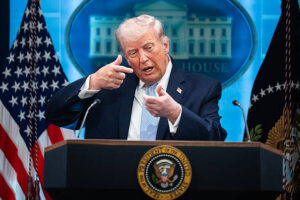
But as reports of dwindling arms stockpiles continued to spread widely, President Trump publicly denied the possible shortfall. “We have massive amounts of arms”, he wrote on Truth Social. “Additionally, large amounts are being manufactured and shipped to the U.S. as needed. Defense companies are building the largest number of plants and factories in our country’s history.”
Professor Simon Adams, Academic Chair of Human Rights, School of Humanities, Arts and Social Sciences at Murdoch University, Australia told Inter Press Service (IPS):, “Trump’s war of choice against Iran has not only impacted weapons stockpiles, it has depleted the ability of some politicians in Washington DC to see people and places on a map as more than targets and annoyances that can impact petrol prices.
Iran is a country of 90 million people and not just the Strait of Hormuz. From the 120 schoolgirls who were killed in an airstrike in Minab to the latest civilian casualties, too many innocent people have died. No more blood should be spilled.
Ongoing threats by President Trump to bomb Iran into the Stone Age and annihilate Iranian civilization constitute an open threat to commit war crimes, he said.
Meanwhile Iran’s rulers continue to publicly hang protesters and deny Iranians their fundamental human rights, said Adams, former President and CEO of the Center for Victims of Torture – a leading international human rights and humanitarian NGO.
The only people who are ‘winning’ this senseless war are weapons manufacturers, oil companies and supporters of theocracy and authoritarianism in both Iran and the United States, declared Adams.
Meanwhile some of the agreements that fell by the wayside include:
• April 2026: An initial short-term, two-week ceasefire was brokered by Pakistan, which was later extended indefinitely before breaking down into intermittent fighting.• June 15, 2026: President Trump and Iranian officials announced that a framework for an interim peace deal and memorandum of understanding (MOU) had been reached to end hostilities and reopen the Strait of Hormuz.
• June 17, 2026: The two nations formally signed the agreement—often referred to as the Islamabad Memorandum—establishing an expanded ceasefire and kicking off a 60-day window to negotiate a final, comprehensive peace treaty.
IPS UN Bureau Report