
FREETOWN, Aug 10 2026 (IPS) - Growing up, Peter George, a young innovator in Bo District in Southern Region, Sierra Leone, watched people dump electronic waste near the farmland where his grandmother cultivated crops.
He told IPS that people would dump electronic waste, such as discarded batteries and other damaged electronic components, near the area where she grew crops, and the chemicals from the waste affected the crops and reduced yields.
But that experience triggered his curiosity and fascination with how electronic devices worked and led him to use e-waste to create solar lamps for students.
“We started using some of the electronic waste to develop solar lamps. These lamps helped students study at night, and we also donated some to other children,” George said.
However, George’s innovation shifted from solar lamps to recycling plastics to make backpacks as plastic pollution worsened in Bo.
“Many people often think plastic pollution is only a problem in Freetown, but the issue is also very serious in provincial cities like Bo. During the rainy season, the roads become flooded because water cannot flow properly in drains due to blockage by plastic waste. This disrupted our school and displaced people,” George said.
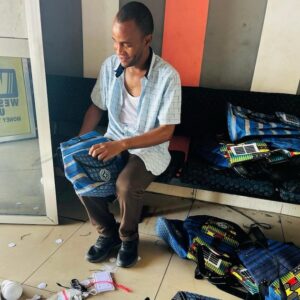
George later founded Ideal Technologies in 2018, a youth-led enterprise operating in Bo District that transforms plastic and electronic waste into solar-powered backpacks and lighting systems for school children.
Through his initiative, George believes he is tackling the problem of e-waste and plastic pollution in Sierra Leone, which has become a serious challenge.
The World Bank estimates that Sierra Leone generates about 130,000 tonnes of plastic waste each year, much of it from single-use plastic bottles, water sachets and plastic bags that pollute the country’s coastline and harm marine life. Globally, electronic waste is also rising rapidly.
The Global E-waste Monitor 2024 says the world generated 62 million tonnes of e-waste in 2022, but less than 22.3 percent was formally collected and recycled.
Authorities say plastic pollution has become a growing threat to Sierra Leone’s coastal ecosystems and tourism industry.
Yet, despite the scale of the challenge, Sierra Leone’s plastic waste management policy is still under development.
“I looked at everything happening around me and started thinking about how to solve the challenge of poor access to electricity, e-waste pollution and plastic pollution. I started developing solar-powered backpacks made from recycled plastic and e-waste.
“During the day, the backpacks are carried like ordinary school bags. At night the attached solar-powered lighting allows children in communities with limited electricity to continue studying after sunset,” George told IPS.
For him, innovation represents more than recycling. He says it is about changing the way people think about waste.
“Things that people saw as waste, I saw as solutions,” said Peter.
Turning Discarded Plastic into Livelihoods
Like George, Manty Sulman Beckley in Freetown, the capital of Sierra Leone, refuses to see plastic as the end of a product’s life. Instead, she recycles waste into everyday items that she sells for a living.
For the past five years, Beckley has transformed single-use plastics into shopping bags, handbags, baskets, chairs, tables and bricks.
The climate activist and founder of the Beckma Empowerment Initiative said her passion for recycling began during childhood, watching her aunt repair and make household furniture. Inspired, she started fixing broken chairs at home.
“As a teenager, I started thinking about how to repair broken chairs around me. Gradually my passion for creating things grew, and as an adult, the passion developed into a plastic recycling initiative after I witnessed how plastic waste was destroying communities across Freetown,” she said.
To source materials, Beckley works with households and young waste collectors in her community.
Despite these efforts, she said securing enough recyclable material remains difficult.
“In my house and surrounding communities, I advocate against throwing plastic waste carelessly. I provide bags for households to collect their plastic waste, which I later gather for recycling.
“Even fifty full rice bags of single-use plastic are not enough to create items like bricks, baskets, and other products, meaning we constantly need to collect more,” she said.
Setbacks
These innovators believe recycling offers an opportunity to give waste a second life, but they say limited financial support and a lack of equipment continue to hinder progress.
For George, the lack of equipment for large-scale production is the key challenge.
“One of our greatest challenges is having the right tools and equipment. If there is greater investment in recycling, especially for young people, it could significantly change the story of single-use plastics, providing income for waste collectors and recyclers,” he told IPS.
But beyond this, Beckley said being a woman in the recycling and innovation space also comes with unique challenges.
“There are people who call asking for products or services, but once they realise a woman is behind the work, they begin to doubt my ability. Some openly say they would rather work with a man,” she said. “I usually tell them that everything posted on my page is work that I have personally done.”
Impact
Over the past two years, George said Ideal Technologies has expanded its work, particularly among schoolchildren in underserved communities. In 2024, his innovation was recognised through the Youth-Led Innovation Challenge, organised by the UNDP and the Environment Protection Agency Sierra Leone, where he was the winner.
The recognition brought financial support that allowed the initiative to reach more communities.
“Through grants from this and other initiatives, we have supported more than 400 school children in rural communities. This does not include people we have supplied products to through partnerships or buyers overseas,” George said.
For Beckley, she measures the rewards of recycling differently and urges greater government support for youth-led recycling initiatives.
“This is my main source of income, and I have also created job opportunities for people who have learnt from me. Some of them now continue making bags and other recycled products on their own,” she said.
IPS UN Bureau Report