
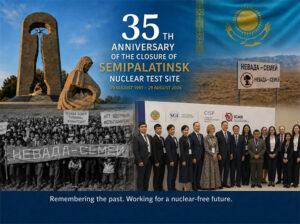
TOKYO / ASTANA, Aug 31 2026 (IPS) - Across the vast steppe of northeastern Kazakhstan, the scars of the Cold War remain visible. At the Semipalatinsk Nuclear Test Site, the Soviet Union conducted 456 nuclear tests between 1949 and 1989, exposing nearby communities to radiation and leaving health and environmental consequences that have endured across generations.
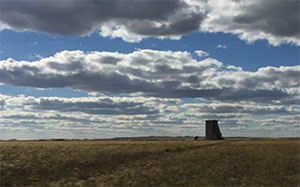
Semipalatinsk Former Nuclear Weapon Test site. Credit: Katsuhiro Asagiri
At a time when nuclear weapons are being reasserted rather than marginalized, Kazakhstan’s choice raises a basic question: Must national security ultimately depend on possessing them?
A Nuclear Test Site Closed by Public Pressure
In 1989, the Kazakh poet Olzhas Suleimenov helped launch the Nevada-Semipalatinsk anti-nuclear movement, linking the Soviet site with Nevada and highlighting the human costs of nuclear testing on both sides of the Cold War. Hundreds of thousands joined protests demanding an end to the tests.
Against that backdrop, then-President Nursultan Nazarbayev signed the decree closing Semipalatinsk on Aug. 29, 1991.
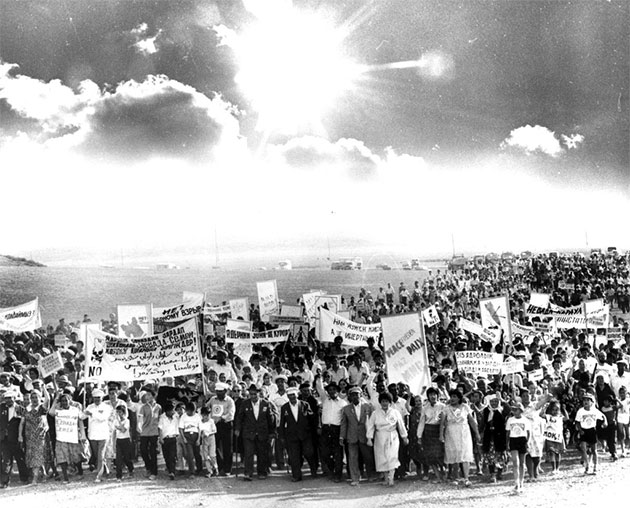
Kazakh civil movement activists gathered to demand a nuclear test ban at the Semipalatinsk test site in August 1989. Credit: armscontrol.org
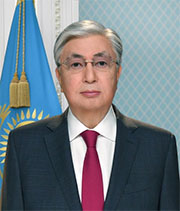
Official portrait of Kassym-Jomart Tokayev. Credit: President of the Republic of Kazakhstan
From Nuclear Victim to Disarmament Advocate
Kazakhstan then sought to turn the experience of Semipalatinsk into a broader disarmament agenda.
It ratified the Comprehensive Nuclear-Test-Ban Treaty and helped establish the Central Asian Nuclear-Weapon-Free Zone with Kyrgyzstan, Tajikistan, Turkmenistan and Uzbekistan. In 2009, at Kazakhstan’s initiative, the U.N. General Assembly designated Aug. 29 as the International Day against Nuclear Tests.
Kazakhstan also hosts facilities in the global system for detecting nuclear explosions, while the International Atomic Energy Agency operates a Low Enriched Uranium Bank in Oskemen to reduce incentives for countries to develop their own enrichment capabilities.
Looking Beyond Warhead Numbers
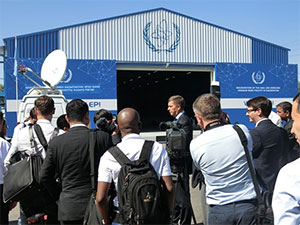
LEU Bank Storage Facility. Credit: Katsuhiro Asagiri
Around Semipalatinsk, concerns about health and environmental damage persist decades after testing ended. That experience has shaped Kazakhstan’s role in the Treaty on the Prohibition of Nuclear Weapons, or TPNW, where it has stressed victim assistance and environmental remediation as well as prohibition.
Together with Kiribati, another country deeply affected by nuclear testing, Kazakhstan has supported efforts to create an international funding mechanism for those purposes.
The principle goes beyond preventing future use: the international community also bears responsibilities for harm already inflicted. Semipalatinsk, Hiroshima, Nagasaki, the Marshall Islands and Kiribati are separated by geography and history but connected by the human cost of the nuclear age.
Kazakhstan and the Role of Civil Society
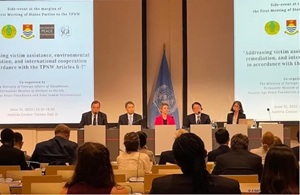
Credit: Katsuhiro Asagiri, Multimedia Director of INPS Japan
Since independence, Kazakhstan has worked with civil society organizations, humanitarian institutions, researchers, survivors, medical experts, young people and faith-based groups to keep the human consequences of nuclear weapons in international debate.
Among them is Soka Gakkai International (SGI), which has long advocated nuclear abolition as a question of human survival and dignity.
At the first Meeting of States Parties to the TPNW in Vienna in 2022, Kazakhstan and Kiribati joined the Nuclear Age Peace Foundation and SGI in organizing a side event on victim assistance and environmental remediation.
In 2023, Kazakhstan’s diplomatic mission, SGI and the Center for International Security and Policy (CISP) organized another Vienna event on the consequences of nuclear testing at Semipalatinsk, including testimony from younger generations living with its legacy. Later that year in Astana, Kazakhstan’s Foreign Ministry and CISP brought together SGI, the International Campaign to Abolish Nuclear Weapons (ICAN), the International Committee of the Red Cross and others for a conference marking the International Day against Nuclear Tests.
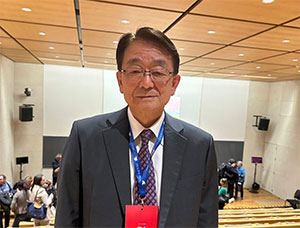
Mr. Hirotsugu Terasaki, Chief Executive Director of SGI Peace Center. Credit: Katsuhiro Asagiri, Multimedia Director of INPS Japan
“Many people in Kazakhstan share the same strong desire for nuclear disarmament because they know firsthand the reality of nuclear suffering,” Terasaki told INPS Japan, drawing a parallel with the aspirations of people in Japan shaped by the atomic bombings of Hiroshima and Nagasaki.
His observation points to a broader dimension of Kazakhstan’s engagement with civil society: cooperation built not only around diplomatic objectives, but also around shared historical experience, humanitarian concerns and a determination to prevent future generations from enduring similar suffering.
These initiatives reflect a broader pattern: states negotiate treaties and security arrangements, while civil society brings survivors’ testimony, medical evidence, environmental damage and intergenerational responsibility into the discussion. For Kazakhstan, whose closure of Semipalatinsk was shaped by a popular anti-nuclear movement, such cooperation is part of the foundation of its disarmament diplomacy.
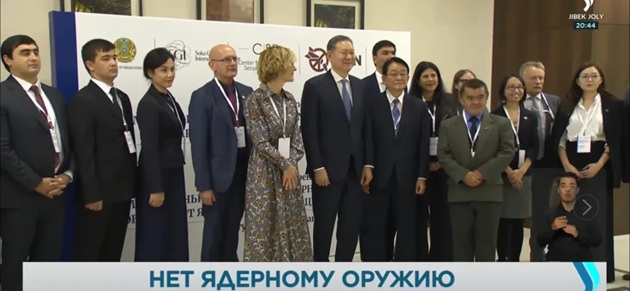
A Group photo of participants of the regional conference on the humanitarian consequences of nuclear weapons and nuclear-free-zone in Central Asia held on August 29, 2023. Credit: Jibek Joly TV Channel
A Nuclear Connection With Japan
Kazakhstan’s relationship with Japan is also shaped by a shared history of nuclear suffering.
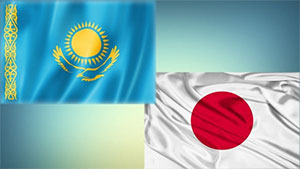
Kazakhstan-Japan
Japan also co-sponsored the U.N. resolution establishing Aug. 29 as the International Day against Nuclear Tests and has worked with Kazakhstan to promote the entry into force of the CTBT.
A World Moving in the Opposite Direction
The international environment surrounding the 35th anniversary is bleak.
More than 10,000 nuclear warheads remain worldwide, and major nuclear powers continue to modernize their arsenals. With New START gone, the United States and Russia no longer operate under a comprehensive, legally binding framework limiting their strategic nuclear forces.
The NPT Review Conference ended in May without a final document, the third consecutive review cycle to end without substantive consensus. The CTBT, opened for signature three decades ago and supported by nearly the entire international community, has still not entered into force.
Memory Is Not Enough
Writing in The Astana Times ahead of the anniversary, Dr. Dauren Aben of the Kazakhstan Institute for Strategic Studies described the lesson of Semipalatinsk in simple terms: not merely to remember, but to “remember and act.”
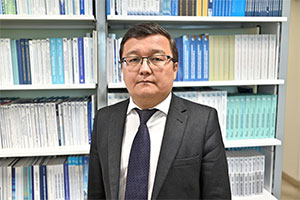
Dauren Abenuly Aben. Credit: KazISS
In 1991, Kazakhstan could preserve the nuclear arsenal it inherited as a symbol of national power, or give it up. It chose the second.
That decision did not eliminate nuclear weapons or guarantee irreversible disarmament. Today, the world may instead be entering a new era of nuclear competition.
But one fact remains: a state that had the opportunity to become a nuclear power chose not to do so.
Over the next 35 years, Kazakhstan connected that choice to nuclear-weapon-free zones, the global test ban, the TPNW, victim assistance and environmental remediation. Its cooperation with SGI and a broad range of civil society organizations forms part of that history.
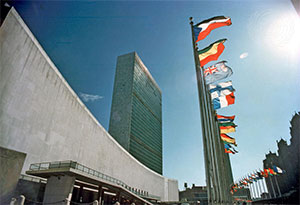
A view of the Headquarters of the United Nations in New York as seen from the north of the UN site. Credit: UN Photo/Yutaka Nagata
Even so, the question posed by the treaty increasingly resembles the question posed by Kazakhstan’s experience:
Does possessing nuclear weapons make nations safer?
Or does genuine security ultimately require a world in which nuclear weapons no longer exist?
Across the former Semipalatinsk testing grounds, traces of the explosions remain — reminders of what humanity has already done with nuclear weapons.
But 35 years ago, Kazakhstan gave the site another meaning: evidence that a country could move from building and testing nuclear weapons toward a deliberate decision to reject them.
The question now is whether the rest of the world still has the political will to make the same choice.
This article is brought to you by INPS Japan and Soka Gakkai International, in consultative status with UN ECOSOC.
IPS UN Bureau

