
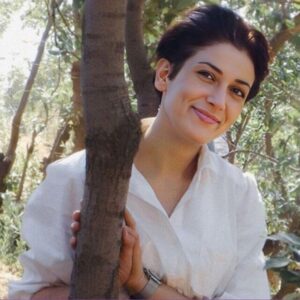
TEHRAN, Sep 1 2026 (IPS) - Writing from the women’s ward of Evin Prison on 10 June 2026, Kurdish political prisoner Pakhshan Azizi, who remains under a death sentence, reflects on her legal case, political principles, humanitarian work, and the broader historical and political dynamics shaping the Middle East.
Azizi opens by stating that “politics and ethics are at the height of their historical degradation”.
She explains that she remained silent for a long time because, for someone imprisoned and condemned to death, every word carries the risk of further punishment or even losing one’s life. Yet she says she can no longer remain silent while others define her identity and speak on her behalf.
Azizi accuses individuals both inside and outside prison of exploiting her case for personal or organisational interests. She argues that people claiming to defend her have instead attempted to marginalise or erase her, turning her case into an object of political competition rather than genuine solidarity.
She describes spending three years in prison and two years under what she calls an unjust and oppressive death sentence. According to her, she is the only female political prisoner under a death sentence whose conviction has been upheld four times. She stresses that neither she nor her lawyer has received any official notification that her execution has been suspended, despite public reports suggesting otherwise. Even if such a suspension existed, she emphasises, it would not mean that her death sentence had been overturned.
She recounts the immense suffering experienced by her family, noting that several relatives have also been imprisoned simply because they are Kurdish. She criticises what she sees as unequal public attention, suggesting that recognition often depends on conforming to political narratives rather than on the reality of one’s work or persecution.
Throughout the letter, Azizi argues that her prosecution has been shaped not only by legal irregularities but also by political manoeuvring behind the scenes, involving actors both inside and outside prison. She says that her experiences of interrogation, ideological pressure, and imprisonment echo the long history of discrimination and marginalisation faced by Kurdish people.
She writes that, over time, she has come to rely only on herself, believing that history will ultimately demonstrate the sincerity of her principles and the consistency of her commitment.
Her political positions
Azizi then sets out her views in nine numbered points.
The Middle East conflict has deep historical rootsShe argues that today’s conflicts cannot be understood solely through the actions of contemporary governments. Instead, she traces the region’s instability back to the post–First World War division of the Middle East by colonial powers.
She describes the current wars as a continuation of that historical process, arguing that the region’s resources—including oil and minerals—have long been exploited by global powers while ordinary people bear the consequences through poverty, sanctions, displacement, and violence.
According to her, civilians are repeatedly sacrificed in conflicts they neither initiated nor control, while political elites continue pursuing geopolitical interests.
Opposition to warAzizi unequivocally condemns the war involving the United States and Israel and rejects military attacks on Iranian territory and the wider Middle East.
She specifically condemns attacks against schools, hospitals, emergency services, universities, and other civilian infrastructure, describing such attacks as war crimes under international law.
She emphasises that children deserve life, not death.
Rejection of allegations of organisational membershipAzizi firmly rejects accusations that she belongs to any political or armed organisation.
She explains that she worked as a social worker and acknowledges that, because of the environment in which she worked in northeastern Syria (Rojava), she inevitably cooperated with various local actors. However, she insists that cooperation in humanitarian work should not be interpreted as organisational membership.
Humanitarian work in SyriaShe describes spending years working in refugee camps in Syria under extremely difficult humanitarian conditions, particularly assisting people displaced by the war and affected by ISIS attacks.
She argues that using isolated photographs or superficial evidence to portray this humanitarian work as proof of political or military affiliation is fundamentally misleading.
Her position on Kurdish rightsAzizi explicitly rejects separatism.
She argues that demands for Kurdish rights should be understood within Iran, advocating federal arrangements and greater recognition of Kurdish communities while preserving the country’s territorial integrity.
Looking beyond Iran, she expresses a longer-term vision of a democratic confederation across the Middle East based on cooperation rather than division.
As a Kurdish woman, she says preserving Kurdish culture and history is both a historical and a human responsibility but insists that separatism has never been the solution.
Peace through dialogueShe argues that genuine peace can only be achieved through dialogue with ordinary people, especially those who have been marginalised and denied opportunities.
Skepticism toward international powersAzizi questions why global powers would suddenly claim to defend her or Kurdish history when those same powers have historically contributed to denying and suppressing Kurdish identity.
She suggests that powerful states often instrumentalise minority communities for their own geopolitical purposes.
Independence from governmentsShe emphasises that social work is independent of governments and political authorities.
Her work, she writes, has always been with people rather than with states.
Commitment to independent civil societyAzizi concludes by reaffirming that she has never belonged to any organisation.
She describes herself as an independent social worker committed to addressing the deep social wounds created by decades of war.
She argues that rebuilding society requires independent civic institutions capable of fostering dignity, culture, and life rather than perpetuating violence.
Azizi ends with a sentence in Kurdish followed by Persian:
“I am one who dies for life, not one who lives for death.”
She closes by expressing gratitude to everyone who has defended her despite political differences, including her family, her lawyer Mohammad Hossein Raisian, and her friends, thanking them for their sincere support.
Source: HRANA News Agency, the news outlet of the Human Rights Activists in Iran.
Translation: Courtesy of Civicus
IPS UN Bureau Report