
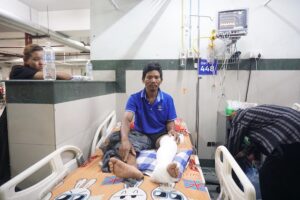
KATHMANDU, Sep 4 2026 (IPS) - That day, Subash Tamang was mining sand along the banks of the Trishuli River near the Trishuli Hydropower Project, working alongside his wife, brother, sister-in-law, and two other family members. Suddenly, he noticed water gushing down from above the hydropower site. His first thought was that the dam had burst.
In an instant, everything changed. He and his family dropped everything and ran toward the river, desperate to save their lives. But then he saw something even more terrifying—huge waves of water were surging from the other side too, carrying clouds of dust and thick black mud.
“I couldn’t make sense of what was happening,” he recalls. “It looked like a monster coming at us.”
He was holding his wife’s hand, trying to run toward the hill, when the flood swept him away—carrying him nearly 500 metres downstream. Helplessly, he watched as the same raging waters took his wife, his brother, his sister-in-law, and three other family members right before his eyes.
“I was holding her hand, and then the flood pulled her away,” he recalls.
His leg was broken in the disaster. An army helicopter later rescued him and brought him to Kathmandu, where he is now receiving treatment at the Trauma Center.
“Our village has been reduced to ruins,” he says. “I don’t know where to go after this.”
Dr Rijan Bhakta Kayastha, a professor at Kathmandu University, says the August 26 disaster started when a massive chunk of glacier and surrounding rock gave way at altitudes of about 5,200 to 1,200 metres above the Lhande River in Tibet, just across the border.
The falling ice and rock turned into a powerful slurry, sending a massive cascade of water, ice, and debris into the Lhande River in Tibet. That surge triggered a devastating flood that raced downstream through the Bhotekoshi River, causing immense destruction.
The death toll from the disaster in Nepal has climbed to 1,114, with 3,996 people still unaccounted for, according to recent government figures. Among the missing are Nepali Hindu pilgrims travelling to the sacred Kailash Mansarovar site in Tibet, as well as tourists from at least 39 countries.
Authorities have recovered bodies swept away by the floods from Rasuwa, Nuwakot, Dhading, Chitwan, Gorkha, Tanahun, Nawalparasi East, and Nawalparasi West districts.
Dr Bijay Jaisi, Director General of the Department of Roads, said initial assessments show flood damage to roads and bridges alone exceeds 30 billion rupees. Around 80 km of roads have been washed away and another 40 km destroyed, while 35 concrete bridges have been damaged and 53 suspension bridges swept away.
The disaster has wreaked havoc on the region’s hydropower infrastructure: the Rasuwagadhi and Chilime projects have been destroyed, and at least 13 other hydropower projects under construction in Rasuwa and Nuwakot districts have sustained significant damage. The Rasuwagadhi hydropower project was completely washed away by the flood.
Most Devastating Flood
“This is one of the deadliest disasters in Nepal’s modern history,” said Dharmaraj Upreti, executive director of the National Disaster Risk Reduction and Management Authority. “We have never faced a flood this devastating and widespread before.”
Such floods are not unique to Nepal. In 2015, a similar disaster is believed to have killed around 200 people. More recently, on July 8, 2025, a sudden outburst from a large glacial lake in Tibet sent a surge of water down the Lende River, sweeping away the Maitri Bridge at Rasuwagadhi and killing at least nine people. Just three weeks later, on July 30, the Bhotekoshi flooded again, damaging roads and other infrastructure along the same corridor, according to Binod Parajuli, a senior divisional hydrologist at Nepal’s Flood Forecasting Division.
Arun Bhakta Shrestha, an expert on climate change and Himalayan glaciers, describes it as a “mountain tsunami”.
Kayastha explains that the disaster was first thought to have been triggered by a glacial lake bursting. But satellite images showed something different: a large chunk of glacier on the Nepal side broke off and slid down. Below it lay what experts call a “debris-covered glacier”—a mix of ice and gravel. When that mass collapsed, the ice and its contents began to melt, releasing a surge of water from the glacial lake. Because the terrain below is extremely steep, the mixture raced downhill at high speed, scouring the land next to the river and quickly turning into a devastating flood.
According to the International Centre for Integrated Mountain Development (ICIMOD), research over 50 years of monitoring reveals that 89% of recorded years experienced a negative glacier mass balance. Crucially, the rate of glacier ice loss doubled post-2000 compared to the preceding decades.
Between 1990 and 2020, Hindu Kush Himalaya glaciers lost roughly 12% of their total area and 9% of their estimated ice volume, amounting to a cumulative loss of up to 27 metres of ice thickness since 1975.
Arun Bhakta Shrestha explained that rising temperatures are melting the glacier’s surface, allowing meltwater to infiltrate the ice. As this water percolates downward, it enlarges existing cracks and forms new fractures called crevasses.
“Crevasses are multiplying rapidly, and as more water pours into them, they grow both wider and deeper,” Sherstha said. “Meltwater moving through the glacier can reach the bedrock below, undermining large ice masses until they collapse. This is precisely the process we are witnessing now. Rising temperatures are hastening the expansion of these fissures.”
Kayastha said the crevasses on the glacier, which had persisted for several months, may have widened. He added that analysing satellite imagery could have helped minimise the damage, but the images were not reviewed.
Climate Change Reshaping Nepal’s High Mountains
Glaciologist Mohan Bahadur Chand warns that climate change is reshaping Nepal’s high mountains in ways that make new kinds of natural disasters more likely.
In recent years, he said, the landscape has become increasingly unstable. Snow once accumulated gently and settled low on the slopes. But as temperatures rise and glaciers retreat upslope, bare ground is becoming exposed. Sections of rock and ice are now left “hanging” precariously on mountain faces.
“It will fall one day or another,” Chand said. “We will see more such processes in the coming days.”
Three days after the flood, Ekat Bahadur Thapa stood at Tribhuvan University Teaching Hospital in Kathmandu, pinning photographs of his son and nephew to the missing-persons board.
His son, 28-year-old Subindra Thapa, and his nephew, 33-year-old Resham Bahadur Thapa, were driving along the China–Nepal border that day. Thapa said they called to tell him they were ready to transport people from Nepal into China and that they would return home soon.
When news of the flood broke, Thapa tried calling his son, but the call wouldn’t connect. He told himself they must have found shelter on the Chinese side. Still, by evening, there had been no word from either of them. But as three days passed after the flood with no word from them, that hope began to fade.
He rushed from hospital to hospital across Kathmandu, desperately searching for survivors, but they were not there. He went to the rivers where bodies had been recovered, hoping against hope. “When they could not be found there either, he returned to his village with a heavy heart,” said Thapa, 58.
On Wednesday, eight days after they vanished, Thapa performed funeral rites according to Hindu tradition, believing the remains to be theirs.
Tears streamed down his face. “How hard it must have been for them,” he said, his voice breaking. “How many times they must have tried to escape.”
He said, “May their souls rest in peace, wherever they are.”
“The early warning system was delayed because we couldn’t detect the flood in time,” says Binod Parajuli, Senior Hydrologist at the National Disaster Risk Reduction and Management Authority. “We were only able to act 15 minutes after the flood entered Nepal. By then, damage had already occurred in Rasuwa. When we finally sent out early warning messages to everyone, people assumed it wouldn’t be much worse than previous floods. But the damage ended up being far greater.”
Parajuli continued, “We couldn’t detect the flood early because it began outside our monitoring area. By the time it reached Nepal, we had very little time to respond. Our system sends SMS alerts when it detects rainfall, but this event did not begin with the kind of rain we normally monitor, making it difficult to issue timely warnings.”
He added that this represents a distinct form of cascading, compounding debris flow, and that early-warning systems for such events have not yet been developed.
Kayastha said that last year, when the flood struck, the area was considered highly vulnerable. The Nepal government was also advised to install an early warning system, which would not have been very expensive. The plan included installing two water-level sensors, a monitoring station and cameras in the field so that people could receive flood information more quickly.
“We couldn’t save the people in the upper reaches, but we were able to save those downstream,” says Rajendra Mishra, Secretary at the Ministry of Agriculture, Forest and Environment. “This flood taught us that simply sending out a message is not the same as an early warning.”
He said that it was important to understand exactly who and what was at risk. Only then can we build a system that observes hazards in real time, communicates alerts effectively, and prepares communities for emergencies. This flood was a warning: bigger floods could come again.”
“Many people also failed to take the early warning seriously,” said Professor Dr Ranjan Kumar Dahal, an engineering geologist and geohazard expert. “Warnings should be communicated in clear, simple language that everyone can understand.”
Disaster Awareness Should Start Young
He added that disaster awareness should also be included in school curricula from an early age so that people understand the risks and know how to respond. The process of risk communication must be better understood.
Manish Raj Pandey, head of climate change at the National Trust for Nature Conservation, said the region’s topography is a key factor. He said, “Glaciers and the lakes they form, together with low-lying wetlands, are expanding for a range of reasons. In Nepal, this mix of steep terrain, glaciers and glacial lakes increases flood risk. At the same time, rising temperatures driven by climate change are intensifying these hazards.”
“Nepal’s severe flooding is driven largely by high-mountain hazards—especially glacier and rock-ice avalanches—exacerbated by a warming climate that is destabilising ice, permafrost, and slopes across the Himalayas,” said Dr Basantraj Adhikari, director of the Center for Disaster Studies at Tribhuvan University’s Institute of Engineering.
“We can’t stop floods, but we can reduce the damage they cause,” Kayastha said. To do that, he said, glaciers and glacial lakes need round-the-clock monitoring, with dedicated staff appointed to watch them.
He said that the government should also install water-level measurement stations on rivers fed by these glaciers and set up an early-warning system. Field cameras can be placed at these stations to provide real-time data, and they’re not expensive to install.
“Adhikari said that as settlements continue to expand along riverbanks, local, provincial, and federal governments must enforce stricter monitoring. Local authorities, he added, should rigorously implement risk-sensitive land-use planning.
Kayastha elaborated, “Many riverside settlements are not in safe locations; this pattern is evident across Nepal. Going forward, the siting of new settlements must be carefully assessed.”
Nandalal Gharti lies in the intensive care unit at the Trauma Centre with severe injuries. That morning, he was working at the customs yard in Timure when he saw the crowd running. He grabbed his youngest son and fled. As the torrent caught up to them, Nandalal pushed his son away from a collapsing wall, but moments later, the floodwaters swept them both away.
He said he had no idea such a massive flood was coming. The sun had been shining brightly just before the disaster.
Gharti was buried in thick mud for several minutes. Choking in the dark, he believed his end had come. With a final burst of strength, he pulled himself free, only to get pinned between two houses. He broke free a second time and scrambled onto a piece of floating driftwood. From there, he watched the area vanish under mud in seconds. Later, a rescue helicopter spotted him clinging to the wood and lifted him and three others to safety.
“I thought I was going to die. I thought my whole family would die too,” Gharti said
Five people remain missing after the flood, including his 10-year-old daughter, 12-year-old son, and his brother and sister-in-law.
He is receiving treatment at the trauma centre. “After surviving, we have nowhere to go,” he said. “We have lost our family and all our property.”
IPS UN Bureau Report