
UNITED NATIONS, Sep 7 2026 (IPS) - More and more, global disarmament discussions are encompassing the humanitarian and environmental impacts of the testing and use of nuclear weapons, as it becomes clear that the legacy of nuclear weapons leaves its mark on multiple generations.
This was the purpose of the international meeting on ‘Victims Assistance and Environmental Remediation’ for countries affected by nuclear weapons. The meeting, held on September 1 in UN Headquarters, convened member states, academia, and civil society organizations, along with representatives from communities directly affected by nuclear weapons use and testing.
The meeting was convened at the direction of the General Assembly under resolutions 79/60 and 80/56, which called for a meeting to be held by 2026 on the lived experiences of communities affected by nuclear weapons and the measures that member states and the international community at large can take to address their concerns. The meeting was chaired by Kazakhstan and Kiribati, two countries that were once sites for nuclear tests in the 20th century. Since then, they are among the former testing states avidly advocating for nuclear disarmament.
This meeting examined the humanitarian and environmental impacts of nuclear weapons use and testing. Many speakers present remarked on the long-lasting effects of exposure to nuclear radiation. The physical, social, economic, and psychological consequences of nuclear use are felt across multiple generations. Persistent health issues are an all-too-common reality among affected communities. People exposed to radiation are more susceptible to noncommunicable diseases like cancer or leukemia or to living with lifelong health conditions.
“The consequences of nuclear weapons do not end when an explosion is over. As the enduring suffering of the Hibakusha—the survivors of Hiroshima and Nagasaki—and the legacy of more than 2000 nuclear tests around the world make clear, the effects of nuclear weapons persist for decades and across generations,” said Izumi Nakamitsu, UN Under-Secretary-General and High Representative of the Office of Disarmament Affairs (UN-ODA).
Nakamitsu said that the efforts to provide remediation should be sustainable; responses to the issues should not depend on “individual projects or temporary initiatives,” but rather on sustained cooperation across national and multilateral systems that have the capacity to preserve knowledge and technical expertise over long periods of time. “Communities need confidence that support will not disappear when a particular project or funding cycle comes to an end.”
Environmental remediation also constitutes, as the representative from Guatemala put it, “an indispensable responsibility” for the international community. The damage inflicted on the environment has rendered farmlands untenable, water systems altered, and impacted areas inhabitable due to radiation.
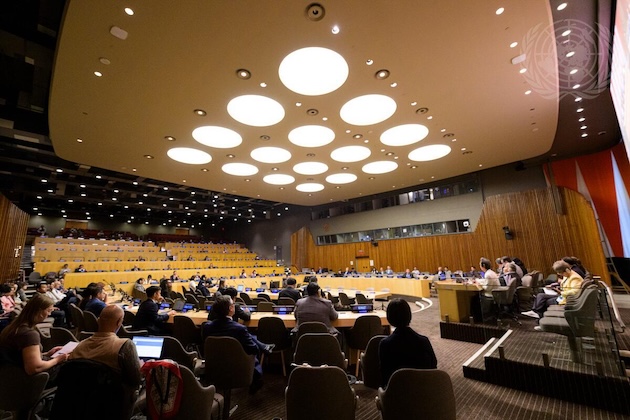
The first UN international meeting on victims’ assistance and environmental remediation for countries affected by nuclear weapons use and testing. Credit: Manuel Elias/UN Photo
Algeria’s representative remarked on the visible impact left by nuclear testing as evident in the Algerian Sahara, where testing was conducted near the towns of Reggane and In-Ekkar. One such result was radioactive lava flowing out from a mountain in the region, which cooled and hardened over time. The state carried out monitoring and environmental assessments of the affected, but as Algeria remarked, this effort cannot be done alone.
The impact also did not occur in a vacuum, as communities in those sites, including pastoralists, were forced to relocate or otherwise live with the outcomes. “Communities near these sites carry the burden that physics imposes: illness, land they cannot cultivate, and the harm of uncertainty,” he said.
States are encouraged to share knowledge and expertise on the methods taken to resolve their issues, such as environmental records for testing sites.
For Pacific Island states, remediation is paramount, for the environment is deeply linked to their cultural heritage. It is made more tragic as they risk losing their connection due to the consequences of nuclear testing.
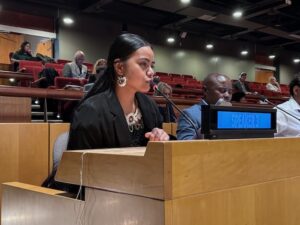
Oemwa Johnston, a fourth-generation nuclear survivor from Kiribati, spoke on how she and other young people continue to carry this impact. “As a young woman and descendant of nuclear survivors, I belong to a generation that did not create nuclear weapons or conduct the nuclear tests of the past. Yet, we have inherited their legacy,” she said.
There was an unanimous call for affected individuals and communities to be at the center of disarmament talks and assistance efforts. Their lived experiences should shape the policies that are meant to support their needs.
“Affected communities cannot be seen only as recipients of assistance or subjects of research. They are knowledge holders,” said Mohamed Ambrosini, Soka Gakkai International’s (SGI) UN Representative for Disarmament.
Interactive dialogue and intergenerational exchanges between hibakusha, affected communities, and younger generations can create the spaces for people to reflect on the impacts of nuclear weapons. Preserving these testimonies and learning from them becomes more urgent as the hibakusha, the survivors of the atomic bombings in Hiroshima and Nagasaki, are aging, Ambrosini warned.
Ambrosini and other civil society members also emphasized that in centering their experiences and recognizing their dignity, this sets the path for them to receive nuclear justice and repatriation for their suffering. These efforts should also respect their dignity and provide them with meaningful spaces to be part of decision-making processes.
There were calls for States to take the responsibility to support affected communities. This should come in two forms: compensation from states through national and federal support programs and official recognition, even apologies, from nuclear powers for their testing.
In the context of Japan, hibakusha and other affected communities receive relief from the government, but not state compensation. While hibakusha are eligible for certain benefits like free health care, the terms for who qualifies for these benefits may be too narrow. Emilie McGlone from Peace Boat, a Japan-based civil society group, argued that the current systems for victim assistance do not include non-Japanese or overseas hibakusha, or people who lived outside the specific geographic boundaries from the hypocenter of the bombings.
“The starting point for all victim assistance is defining who is recognized. Japan’s experience shows that while official definitions may be narrow, victims themselves as well as civil society in affected areas advocate for broader rights. Civil society and diverse impacted voices must therefore be involved in the design of victim assistance policies,” said McGlone.
The meeting recognized the current international frameworks that limit or prohibit nuclear weapons use and testing, such as the Comprehensive Nuclear-Test-Ban Treaty (CTBT) and the Treaty on the Non-Proliferation of Nuclear Weapons (NPT). It also held up the Treaty for the Prohibition of Nuclear Weapons (TPNW), which carries provisions for victim assistance and environmental remediation, as outlined in Articles VI and VII of the treaty.
As Bangladesh’s delegate noted, the TPNW recognizes that “addressing the use of nuclear weapons must go hand in hand with preventing their future use.” As of now, 100 countries have either signed or ratified the treaty, which calls for complete nuclear disarmament, though this does not include the current nuclear-armed states.
Note: This article is brought to you by IPS Noram in collaboration with INPS Japan and Soka Gakkai International in consultative status with ECOSOC.
IPS UN Bureau Report