
SRINAGAR, India, Sep 14 2026 (IPS) - An international survey released by Earth4All has found a growing crisis of trust in governments, widespread anger over inequality, and strong public support for major economic reforms, suggesting that many people across the world believe current political and economic systems are failing to serve ordinary citizens.
The report, Rebuild Trust: Rigged Economies, Fractured Societies and the Case for Change, surveyed people in 17 countries representing 58 percent of global GDP, 38 percent of the world’s population, and 37 percent of global carbon emissions. Its findings paint a picture of societies that feel increasingly divided, economically insecure, and disconnected from political institutions.
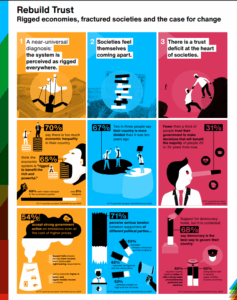
As per the report, nearly two-thirds of respondents said they believe their country’s economic system is “rigged” to benefit the rich and powerful. Seven in ten said there is too much economic inequality in their country, while 69 percent called for major changes to economic systems to improve life for most people.
“The survey results show a mismatch between public support for economic change and what mainstream political parties are willing to offer,” the report’s authors, Owen Gaffney and Kate Pickett, write. They argue that the findings reveal an opportunity for governments to build new social contracts based on fairness, economic security, and long-term wellbeing.
The survey comes at a time when many countries are grappling with rising living costs, political polarisation, climate pressures, and growing public frustration with institutions.
One of the report’s most striking conclusions is that many people feel their societies are becoming more fractured.
Across the 17 countries surveyed, 67 percent said their country is more divided today than it was a decade ago. More than seven in ten respondents reported serious tensions between supporters of different political parties. Nearly two-thirds saw conflict between rich and poor, while similar numbers perceived tensions between immigrant and native-born populations.
The authors argue that these divisions are linked not only to economic conditions but also to a broader erosion of trust.
“Societies feel themselves coming apart. There is a trust deficit at the heart of societies,” reads the report.
Only 31 percent of respondents said they trust their governments to make decisions that will benefit the majority of people 20 or 30 years into the future. This was one of the lowest-rated measures in the survey.
The report also highlights a less visible issue. Many people feel they are not treated with respect and dignity.
Across all surveyed countries, only 41 percent agreed that people like them are treated with respect and dignity. The authors note that feelings of disrespect and humiliation can fuel political alienation and social resentment.
“A society in which one in four people feel they do not receive respect contains significant combustible material,” the report states. “Many people feel unseen, believe the system is rigged and do not experience their society as a collective enterprise.”
Asian countries included in the survey showed significant differences in public attitudes.
Indonesia emerged as one of the strongest supporters of economic reform. Nearly three-quarters of Indonesians said there is too much inequality in their country, while 74 percent believed the system benefits the wealthy. A remarkable 78 percent supported major economic changes, the highest level among all countries surveyed.
Indonesians also showed strong backing for climate action. Sixty-eight per cent said governments should take strong action against climate change even if it results in higher prices.
Yet Indonesia appeared less polarised than many Western countries. Only 53 percent believed the country is more divided than it was ten years ago, significantly below the global average.
Japan presented a different picture.
Trust in government was among the lowest recorded in the survey. Only 19 percent of Japanese respondents said they trusted their government to make long-term decisions benefiting the majority of citizens. Just one fifth felt they were treated with respect and dignity.
The findings also revealed unexpectedly strong support for authoritarian leadership in Japan. Nearly half of respondents agreed that the country would be better off with a strong leader unconstrained by parliament and elections. Meanwhile, only half said democracy was the best system of government.
India also featured prominently in the survey. According to comparative data in the report, 66 percent of Indian respondents agreed that there is too much economic inequality in the country, close to the international average. India ranked among countries where a majority still felt they were treated with respect and dignity, recording one of the highest scores in the survey on that measure.
Despite widespread frustration with governments and economic systems, the survey found continued support for democracy.
Overall, 68 percent of respondents said democracy remains the best way to govern their country. However, support was not universal. Forty percent also agreed that their country would be better off with a strong leader who does not have to worry about parliament or elections.
The authors describe this as a warning sign rather than a rejection of democracy itself.
In countries such as Brazil and Japan, support for strong leaders reached especially high levels. In Brazil, 51 percent backed the idea of a leader unconstrained by elections, while 63 percent still supported democracy. In Japan, support for strong leadership stood at 46 percent.
The United States presented a contrasting picture. Only 26 percent favoured a strong leader outside democratic constraints, while 68 percent supported democracy as the preferred form of government.
The report warns that declining trust in institutions can create openings for anti-democratic movements if governments fail to address public concerns about fairness and economic opportunity.
Climate Action Retains Public Backing
Despite growing economic anxieties, the survey found continued support for climate action.
More than half of respondents said governments should take strong action to reduce greenhouse gas emissions even if it leads to higher prices. Support was strongest in middle-income countries and weaker among lower-income households and politically conservative respondents.
The authors argue that climate policies are more likely to succeed when paired with measures that address economic inequality and social insecurity.
Public resistance to climate action often grows when people believe they are being asked to bear unfair costs while wealthier groups benefit from the existing system, the report suggests.
Kate Pickett, one of the report’s authors and a well-known researcher on inequality and social wellbeing, has long argued that unequal societies tend to experience weaker social cohesion and lower levels of trust. The findings of the new survey appear to reinforce that argument.
Economic Anxiety Remains Widespread
Beyond questions of trust and politics, the survey highlights persistent worries about basic economic security.
Across the countries surveyed, 41 percent of respondents said they were concerned about having enough money to cover their basic needs during the coming year. Economic anxiety was particularly high in countries facing inflation and financial instability.
Argentina recorded the highest levels of economic insecurity. More than two-thirds of respondents worried about covering basic needs, and 78 percent supported major economic reforms.
Even in wealthier countries, concerns about inequality remained widespread.
In the United States, 62 percent said there was too much inequality. In Sweden, often regarded as one of the world’s more equal societies, 71 percent shared the same view. Australia recorded 64 percent.
The authors argue that economic growth alone is no longer enough to reassure citizens.
Instead, people increasingly judge systems based on fairness, opportunity, and whether prosperity is shared.
The Earth4All initiative was launched by organisations including the Club of Rome, the Potsdam Institute for Climate Impact Research, the Stockholm Resilience Centre, and the Norwegian Business School. It seeks to identify pathways toward sustainable prosperity and social wellbeing.
The report’s authors say the findings should serve as a wake-up call for political leaders.
Rather than viewing public frustration as a temporary reaction to economic shocks, they argue that governments should recognize it as evidence of deeper structural problems.
The survey reveals what the authors call a “near-universal diagnosis”. Across different political systems, cultures, and income levels, large majorities share the belief that current economic arrangements favour elites while leaving ordinary citizens behind.
IPS UN Bureau Report