
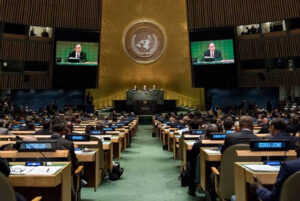
UNITED NATIONS, Sep 15 2026 (IPS) - As the race for the election of a new Secretary-General (UNSG) gathers momentum, the spotlight is on the 193-member General Assembly, the highest policy making body at the United Nations, which has refused to assert itself and continues to play a subservient role in the elections of UNSGs.
Perhaps this year will be no exception either.
According to Article 97 of the United Nations Charter, the Secretary-General is appointed by the General Assembly upon the recommendation of the Security Council (SC), which puts forward a single recommended candidate.
Traditionally, the General Assembly (GA) has always approved that recommendation, usually by acclamation or a resolution
But the GA has never rejected a SC nominee. Despite a growing demand for a female SG in the 81- year history of the UN, what if the SC nominee this year is a male candidate.?
Isn’t it time for the GA to assert its authority and reject any candidates– male or female—who lacks the right credentials for the post of Chief Administrative Officer of the United Nations? Isn’t it also time for the GA to cease being a mere rubber stamp — approving without questioning the Security Council decision?
Richard Gowan, Director for Global Issues and Institutions and a longtime UN watcher at the Brussels-based Crisis Group, told Inter Press Service (IPS): “I really, really doubt that the General Assembly would reject a candidate approved by the Security Council– unless he or she was a certified axe murderer. And even then, it might be a close call.”
There has been a lot of talk about the General Assembly asserting itself more in the selection process. But member states are also worried that the veto powers in the Council will not be able to agree on anyone at all. There is more and more talk of the Council reaching the end of the year without making a recommendation, he said.
“ I think that there will be a deal in the end, but to be frank if the veto powers do agree on a candidate, a lot of countries will conclude that they have to accept him or her. Even if diplomats in New York think the person on offer is sub-standard, their political bosses in capitals will not want to offend Washington, Beijing and Moscow by challenging the choice”.
* I can imagine a situation in which the veto powers force through a candidate from outside Latin America and the Caribbean, leading the Latin Americans to abstain or vote against them in protest over the breach of the regional rotation principle. Although a lot of members do really want a female Secretary-General, I find it less likely that a lot of states would vote against a man on principle.”
* I think that a lot of diplomats would worry about damaging their relations with the next Secretary-General before they even take office. And in the final analysis, there will be a tendency to say that it is better to give the next UN chief a broad endorsement for the sake of the organization. Turning the next Secretary-General into a lame duck in advance would look bad, declared Gowan.
Jesselina Rana, UN Advisor, CIVICUS, a global alliance of civil society organisations and activists, told IPS in theory the GA can push back if a woman is not recommended, once voting starts. It only takes a simple majority present and voting to appoint the SG. In practice, it never has happened.
Real pressure has to come earlier. This means the GA asking for multiple candidates before the Security Council makes its recommendation or even holding GA straw polls to gauge preferences., she said.
Dr Palitha Kohona, former Chief of the UN Treaty Section, told IPS to seek clarity from the Charter, which substantially reflects the reality of the world after the Second World War, would not be particularly helpful in the appointment of a new SG.
“We continue to be dominated by that reality which in the view of some commentators, including the present writer, is outdated. Practices have been developed which essentially perpetuate that reality. Whatever the P5 decides is likely to prevail.”
The Charter itself says little on the appointment process of the SG. Article 97 stipulates that the General Assembly will appoint a Secretary-General on the recommendation of the Security Council. Resolutions 11/1 of 1946 and 54/246 of 1997 are important in this regard, said Dr Kohona, a former Permanent Representative of Sri Lanka to the United Nations.
The Security Council (SC) has continued to play the preeminent role in the selection of a candidate for the position of SG. In fact, the role played by the veto wielding Permanent 5 (P5) is critical.
In the first instance, he pointed out, the SC will seek consensus prior to recommending a candidate to the GA, although 9 votes in favour of a candidate in the Council would suffice to progress the matter. If consensus is not feasible, the Council will vote on the candidates available.
The practice of conducting straw polls among the members of the SC has become popular in recent times. To the disconcert of many members of the world body, the recommendation is adopted at a private meeting in accordance with Rule 48 of the Provisional Rules of Procedure. The P5 has fiercely hung on to this privilege.
“It is now almost mandatory for aspirants to the post of SG to undertake visits to the capitals of the P5 to seek their blessings and not say or do anything that would cause them unease”.
In South Asia, people are familiar with the somewhat similar practice of making offerings to deities in order to obtain divine blessings prior to undertaking any important task.
This was not always the case. When, in 1951, Trygve Lie was vetoed by the Soviet Union, as he sought his second term, the US had him appointed through a clear majority of votes in the GA.
Given the difficulties that Trygve Lie faced subsequently, especially in dealing with a hostile Soviet Union, it would be unlikely that such a break from accepted practice would be adopted today. The life of a SG appointed in this manner would simply be too difficult, he argued.
While many would consider that at least now a woman should occupy the position of SG, the present writer subscribes to the view, that the best candidate should be picked to head this supremely important global position, irrespective of gender.
“The ideal candidate should be able to work effectively with the P5, maintain the confidence of the members of the Organization, manage a complex universal bureaucracy and advance the goals and ideals of the Character without fear or favour, declared Dr Kohona.
Meanwhile, in an article published in PassBlue last month, Graca Machel, a co-founder and the Deputy Chair of The Elders, an independent group of global leaders, said historically, the selection of a new secretary-general has been treated as the domain of the UN Security Council, especially its five permanent members, known as “the P5.”
But the wording of the UN Charter is clear that while the Council should recommend a candidate, the appointment is made by the General Assembly. If the P5 propose an unsuitable candidate for reasons of realpolitik, the states of the General Assembly can and should reject them and insist that more suitable individuals be put forward said Machel, the only woman in modern history to have served as First Lady of two countries: South Africa and Mozambique.
“The concentration of such power in the hands of only five member states — Britain, China, France, Russia and the US — has never been consistent with the democratic spirit of multilateralism. It is particularly indefensible today, when two permanent members, Russia and the US, have recently breached the Charter through launching unilateral wars of aggression,” she pointed out.
The concentration of such power in the hands of only five member states — Britain, China, France, Russia and the US — has never been consistent with the democratic spirit of multilateralism. It is particularly indefensible today, when two permanent members, Russia and the US, have recently breached the Charter through launching unilateral wars of aggression.
“As an African woman who fought in my country’s liberation struggle and has spent decades working for peace, justice and human dignity, I find it profoundly troubling that the UN still reflects, at its uppermost levels of the Security Council, the power hierarchies of 1945 and the colonial era”, she declared.
All 193 members of the General Assembly bear responsibility for ensuring a credible process and must affirm their commitment to multilateralism, universal human rights and the rules-based international order. They have an obligation to ensure that those principles are reflected in the candidate they support.
“If the Security Council presents a candidate who lacks the independence, experience, integrity and broad confidence required for the office, the General Assembly is not bound to rubber-stamp that choice. Member states have the right and responsibility to demand a candidate worthy of the Charter and of the peoples in whose name the UN acts”.
The next secretary-general cannot be merely an administrator of international consensus, especially when consensus itself is often paralyzed. The office requires a leader with moral courage, political judgment and strategic independence — someone to speak truth to power, to work quietly and effectively behind the scenes and to retain the trust of governments without becoming beholden to any of them, declared Machel.
IPS UN Bureau Report