
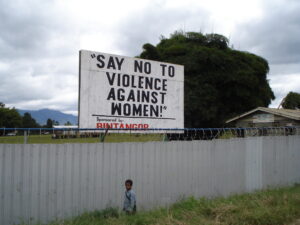
SYDNEY, Australia, Sep 22 2026 (IPS) - In the remote Highlands region of Papua New Guinea (PNG), humanitarians are life-saving beacons to women and girls facing myriad forms of violence. Despite years of awareness programmes and advocacy, the incidence of domestic and sexual violence is not declining. But Janet Kilea is one survivor who has rejected the fear and stigma of her experience and now dedicates her energy to transforming other women’s lives.
“I feel for other women who are going through the challenges I went through,” Kilea, who works in communities with the international medical humanitarian organisation Médecins Sans Frontières (MSF) in the mountainous Jiwaka Province, told IPS. “I need to use my experience to advocate for and empower women. Women should come out and not be silent about gender-based violence.”
Globally, about 31.6 percent of women have been subjected to physical or sexual violence, reports the World Health Organization (WHO), compared to an estimated 64 percent, more than double, in PNG, which has a population of about 10 million. Yet abuse of women, whether physical, psychological or economic, is of worldwide concern. It affects women and girls in both developed and developing countries, with the WHO claiming that SDG 5.2, which aims to eliminate it, is severely off-track and will not, on current trends, be achieved by 2030.
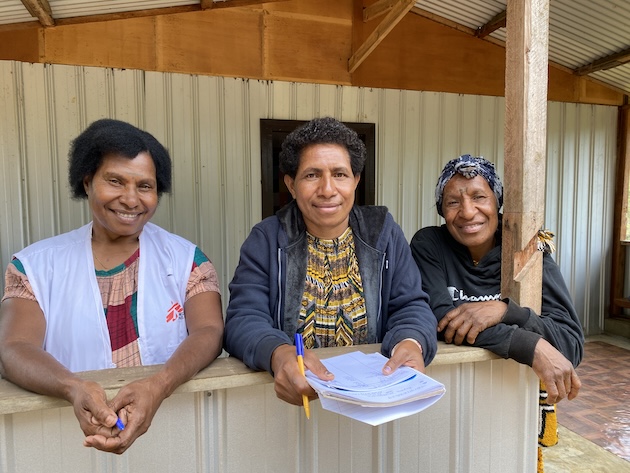
MSF’s Community Engagement Supervisor, Janet Kilea (L), with Community Health Worker, Judith (C), and Village Health Volunteer, Cathy (R), in Mondumil Village, Jiwaka Province, PNG. Credit: Sophie McNamara/MSF
And, in the PNG highlands, there are numerous barriers to changing the behaviours that endanger women’s lives and getting medical and support services to those who desperately need them. Most people live in isolated communities scattered across a vast rugged terrain of impenetrable forests, arduous high-altitude areas and deep valleys. Many do not have access to roads, while state services, including law enforcement, rarely reach far beyond major towns.
Across the Pacific, rural women and girls are particularly vulnerable, given they are twice as likely to live in poverty as those in urban centres, reports the UN Women, and face entrenched customary beliefs and practices that reinforce notions of gender inequality. Polygamous marriage, for instance, increases the risk of intimate partner violence by 24 percent, according to the World Bank. In the Pacific, “men still see women and girls as their property and believe that they are entitled to control them. And so far there are no efforts led by men to change the situation,” Colin Tukuitonga, Professor of Public Health at New Zealand’s University of Auckland, told IPS.
“In Jiwaka Province, it is estimated that 60 percent of women and girls are experiencing some form of violence,” Frédérique Butez, co-ordinator of MSF’s project in Jiwaka Province, told IPS. And “right now there is only one operational facility in Minj town, one facility providing family support centre services, which are integrated services within the public health facility with medical consultations and direct first aid and support. And then appropriate referrals to protection or legal services, according to the needs of the survivor,” she elaborated.
The suffering of survivors can be immense. Their ordeals may have involved weapons, such as knives or machetes, and resulted in chronic pain, sexually transmitted diseases, reproductive health issues, severe trauma or depression. The provision of external support services is crucial, too, as women frequently contend with stigma and pressure within families and communities to not report their abuse to authorities.
But that has not diminished Kilea’s resolve to make a difference. Gender-based violence (GBV) “is a very sensitive issue in our culture, which is taboo. So, when we go into the community, we talk with the women about their daily lives. We then talk about the root causes of GBV and start a conversation with the women. We create a space to share experiences,” Kilea explained.
MSF also trains village-health volunteers, critical first responders who are trusted within communities. “They are the heart of the project, because they are the focal point inside each community to give the first crucial aid care. They are the ones giving women access to the support and care that they need,” said Butez.
Jiwaka is a relatively new province established on the PNG mainland in 2012, and the provincial government, which provides for a rural-based population of about 343,987 people, is still developing its service outreach. “In terms of the scale of the needs and services, it is quite huge,” Butez said. But MSF, in partnership with Jiwaka Province, is using its expertise and resources to boost the skills of local healthcare workers and the capacity of medical and psychosocial services and support the government’s policy planning.
The scale of the public health needs is also recognised at the national level. Legislation, including the Criminal Code and 2013 Family Protection Act, outlaw domestic violence and violence against women and children. PNG’s gender-based violence response strategy promotes zero tolerance and outlines objectives, such as the development of effective response and service delivery to those affected and the scaling up of public message programs aimed at prevention.
Some political leaders have also spoken out. In March, Prime Minister James Marape told the PNG parliament that ‘domestic violence is a no amidst us. You cannot chest-beat as a leader if you are abusing your wife at home. Simple. Period,’ he declared, claiming that the country ‘will not progress if the fundamental fabric of our society is weakened.’
Nevertheless, women are still struggling to access timely support, and impunity continues for the vast majority of perpetrators. A progress review by the National Gender-Based Violence Secretariat last year reported a fall in the proportion of respondents witnessing domestic violence in their homes from 70 percent in 2016 to 51 percent in 2025. But, in contrast, it found a 210 percent increase in reported cases of violence against women since 1986 and a major shortfall in objectives being implemented. ‘Governance structures remain fragmented and under-resourced, with only 5 of 22 provinces having functional GBV secretariats and just 12 receiving annual funding,’ claims the report, while ‘the justice system is failing survivors with conviction rates for GBV cases as low as 0.5 percent in some regions.’
“Implementation is a challenge across the [Pacific Islands] region,” Tukuitonga emphasised. One hurdle is that strategic plans often exceed the budgetary capacity of governments, and “the second issue is that there are often not the skills locally to implement the plans effectively.”
Kilea, in coming to the aid of women and girls facing life-threatening situations every day, is part of efforts to address the latter. “I remember a woman I supported, who had three sons and one daughter. Her husband beat her regularly and took the money,’ Kilea recounted. She had no income and wasn’t working. She was also illiterate and uneducated and found it very difficult to know what to do. But Kilea was able to guide her on how to be patient and focus on her children while searching for opportunities to gain financial independence. “Soon she heard about an opportunity to do voluntary work, which has now led to daily paid work,” enabling her to leave the abusive relationship she was in and move to safer accommodation with her children.
Butez is buoyed to see the project leading to successes and being welcomed in the province. “The communities really accept us. And, as an organisation, it is very important that the trust with the communities is there, because without it we couldn’t work,” said Butez. “It is something that we are really proud of.”
The work of humanitarians will be critical now and in the future, to addressing the hardships and suffering that gender-based violence causes, with PNG’s GBV secretariat predicting that it could affect up to 8 million women in the country by 2046.
IPS UN Bureau Report