

PORTLAND, USA, Sep 22 2026 (IPS) - Marriage is declining in many countries, with fewer people marrying and many postponing marriage until later in life. At the same time, increasing numbers of men and women are choosing cohabitation instead of marriage.
Various social, economic, and legal factors have contributed to this shift from marriage to cohabitation. Moreover, cohabitation is increasingly not simply a prelude to marriage but, in many cases, an alternative to it. Although its prevalence varies considerably across regions and countries, cohabitation among unmarried couples has continued to rise in many parts of the world.
Historical demographic trends indicate that marriage has become less common over the past several decades, with particularly pronounced declines among younger adults. Nearly 90% of the world’s population lives in a country where marriage rates are declining. This change in union formation is part of the broader transformation in family and household patterns around the world.
In the mid-20th century, about 65% to 70% of adults worldwide were married. By 2021, however, the global share had declined to approximately 50% to 55%.
The proportion of married adults has declined across major age groups. In the United States, for example, the share of adults who were married decreased across all major age groups between 1960 and 2010 (Figure 1).
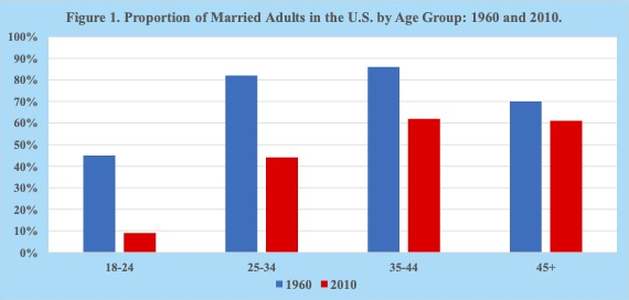
Source: U.S Census Bureau.
In addition, declines in marriage rates have been accompanied by substantial delays in marriage. Several decades ago, women in many countries typically married in their early or mid-twenties. Today, the median age at first marriage for women has risen to the late twenties or early thirties in many developed countries.
Historical demographic trends indicate that marriage has become less common over the past several decades, with particularly pronounced declines among younger adults. Nearly 90% of the world’s population lives in a country where marriage rates are declining. This change in union formation is part of the broader transformation in family and household patterns around the world
Marriage is therefore becoming less common in an increasing number of countries. At the same time, cohabitation has become increasingly widespread.
Once more common among people with lower levels of education and socio-economic status, cohabitation has in recent decades spread across educational and socioeconomic groups, making it a more broadly established form of partnership.
Cohabitation is particularly common in Central and South America, where levels are among the highest in the world. Rates of 40% or more of all unions are found in Panama, Nicaragua, Cuba, the Dominican Republic, and Haiti.
Brazil provides another striking example. In 2022, nearly 40% of couples were in consensual or cohabiting unions, compared with about 38% in civil and religious marriages. For the first time, consensual unions surpassed civil and religious marriages as the most common form of union.
The rise of cohabitation in Latin American countries has also been accompanied by increasing proportions of children being born outside of marriage. From roughly 2016 to 2020, approximately 75% of children in Latin America were born outside marriage. The proportions ranged from about 60% in Guatemala and Ecuador to more than 80% in Colombia and Panama.
By contrast, cohabitation remains less common in Asia and the Middle East. These lower rates are generally attributed to the continuing influence of traditional family structures, marriage practices, and cultural and religious norms.
In addition, some countries have cultural restrictions and laws prohibiting sex outside of marriage, effectively making cohabitation illegal. These include Afghanistan, Egypt, Indonesia, Iran, Kuwait, Malaysia, Mauritania, Morocco, Pakistan, Qatar, Saudi Arabia, Sudan, the United Arab Emirates, and Yemen. In most of these countries, a large majority of adults aged 18 to 49 are married.
Various factors have contributed to the shift from marriage toward cohabitation in many countries. Unlike marriage, cohabitation generally involves fewer legal procedures, costs, and formalities and may avoid some of the financial and legal complications that may arise from divorce (Table 1).

Source: Author’s compilation.
Cohabitation also gives men and women opportunities to get to know each other, assess their compatibility, financial circumstances, and make decisions about their future without immediately assuming the legal obligations of marriage. For many couples, therefore, cohabitation has become an alternative to marriage rather than simply a step toward it.
The widespread availability of modern contraceptives has given men and women greater flexibility in forming personal relationships and greater control over the timing and number of their children. Other important factors include urbanization, rising educational attainment, increasing female labor-force participation, financial pressures and unemployment, changing priorities regarding careers, personal growth, and independence, and evolving social and economic roles of men and women.
Additional factors include the rising costs associated with marriage, the potential financial consequences of divorce, changes in laws governing unmarried couples, and growing social acceptance of cohabitation.
Among OECD countries, about 12% of adults aged 20 and older lived in a cohabiting union around 2023. The proportions were considerably higher in some OECD countries, including Iceland (22%), Sweden (20%), and France (19%).
As in many Latin American countries, a large proportion of the births in OECD countries now occur outside marriage. A half century ago, fewer than 10% of children were born outside of marriage in most OECD countries. By 2020, that share had risen to more than 30% in most countries and to more than half in several, including Denmark, Estonia, France, Iceland, Norway, and Sweden.
In sum, although substantial regional variations persist, particularly in more traditional and religious societies, marriage has declined significantly in most countries over the past several decades. Many men and women are also postponing marriage until later in life. At the same time, cohabitation among unmarried couples has become increasingly common, reflecting a broader transformation in partnership patterns.
Joseph Chamie is a consulting demographer and a former director of the United Nations Population Division.