
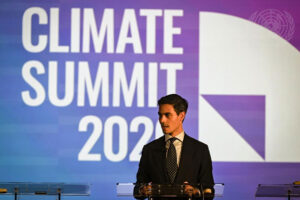
UNITED NATIONS, Sep 29 2026 (IPS) - On September 23, the United Nations held its 2026 Climate Summit as part of the High-Level Week of the 81st session of the General Assembly (UNGA 81). Convening civil society actors, climate scientists, major energy producers and consumers, development experts, and world leaders, the summit addressed critical strategies to mitigate the compounding impacts of the climate crisis and accelerate progress toward the Sustainable Development Goals (SDGs).
“The world is crying out for climate justice in mitigation, adaptation, and finance. We must answer that call with action, and we don’t have a moment to lose,” said UN Secretary-General António Guterres in his opening remarks. “But emissions are still rising when they must plummet, and fossil fuel expansion continues, defying science, economics, and common sense.”
“We have seen our fossil fuel dependence wreak havoc, driving up costs, draining budgets, squeezing households, and leaving countries at the mercy of conflicts and decisions far beyond their borders. Meanwhile, fossil fuel companies are banking windfall profits while everyday people foot the bill. Doubling down on oil and gas will only lock in vulnerability for decades,” Guterres added.
Nearly a decade after the adoption of the Paris Agreement, the summit comes as climate experts warn of a dangerous new phase in the global climate crisis. New findings project it is virtually “inevitable” that global temperatures will exceed 1.5°C above pre-industrial levels within the next ten years.
This overshoot presents widespread, multifaceted risks—from extreme weather patterns to escalating public health emergencies. Intensifying heatwaves, droughts, wildfires, storms, and floods continue to cause millions of deaths annually, drive mass displacement, and destroy critical infrastructure, particularly in low-lying coastal regions.
Prime Minister Tarique Rahman of Bangladesh—one of the world’s most climate-vulnerable regions—warned the General Assembly that up to 18 percent of the country’s coastal land could be entirely submerged by rising seas, endangering the security and livelihoods of tens of millions. President Naiqama Lalabalavu of Fiji also emphasized that over half of his country’s population lives within a kilometer of the shore, leaving communities at a significant risk of being exposed to natural disasters. He further noted that the stock of fish available to each Fijian is estimated to decline by nearly 25 percent by 2050, threatening widespread food insecurity across the region.
The compounding impact of these disasters is also linked to depressed crop yields—which significantly impact food insecurity, accelerate biodiversity loss, and cause widespread disease outbreaks. Higher temperatures directly drive the spread of vector-borne illnesses, while rising sea levels and flooding exacerbate waterborne diseases. As a result, countries worldwide continue to sustain massive economic and human costs while aid organizations and health sectors struggle to keep up with the influx of needs.
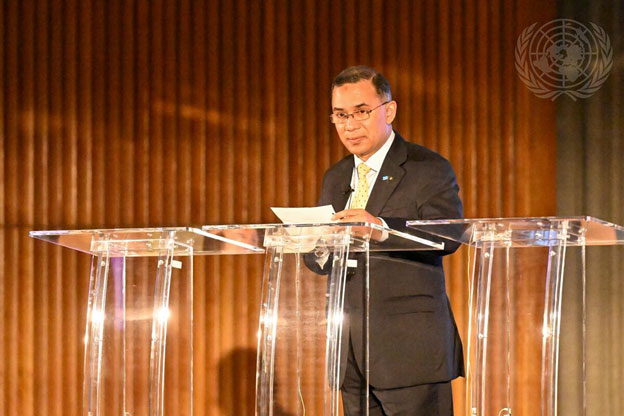
Tarique Rahman, Prime Minister of Bangladesh, addresses the High-level Meeting on Climate Action and the Just Transition. Credit: UN Photo/Laura Jarriel
“We just lived through the hottest July and August on record. Global sea surface temperatures are at a record high, and the worst is yet to come,” said Celeste Saulo, Secretary-General of the World Meteorological Organization (WMO). “We enter a dangerous terrain where we’re likely to cross a number of tipping point systems that not only regulate the stability of the climate system, but also fundamentally determine life support for human development.”
Numerous speakers also underscored the severity of an immensely powerful “Super El Niño” rapidly forming in the Pacific Ocean, which WMO has described as potentially the strongest in at least a millennium. Data from the National Oceanic and Atmospheric Administration’s (NOAA) Climate Prediction Center indicate a 90 percent chance that this El Niño will mark one of the most extreme weather events of the 2026-2027 winter season.
Saulo warned that the global impacts of the impending El Niño will be massive and long-lasting, and will cause 2026 to become the hottest year on record. Yvonne Aki-Sawyerr, Mayor of Freetown, Sierra Leone, told the General Assembly that damages in Africa alone could exceed USD 20 billion, with comparable losses projected across other highly climate-vulnerable regions.
The summit sets new goals for the international community: to return global temperatures to below 1.5°C as quickly as possible, limit the severity and duration of ongoing impacts from the overshoot, and facilitate the global transition to renewable energy. Guterres warned that the current generation sits at a critical turning point—it is the first to possess the tools to end the climate crisis, and the last with the opportunity to avert a “climate catastrophe.”
The main pathways for climate action highlighted during the summit included increased intergovernmental cooperation, sustained investment in climate adaptation and resilience monitoring systems, and wider-scale deployment of renewable energy. In recent years, renewables have become significantly cheaper than traditional fossil fuels—such as coal, oil, and natural gas—while generating far lower emissions, facilitating sustainable development, and potentially averting hundreds of billions of dollars in climate-related losses worldwide.
While countries representing roughly 90 percent of all global emissions have submitted updated Nationally Determined Contributions (NDCs)—signaling widespread political commitment to the Paris Agreement in the midst of heightened geopolitical tensions—current NDCs are projected to continue to fall short of the emission reductions required to prevent an overshoot of the 1.5°C target.
Michael R. Bloomberg, the UN Secretary-General’s Special Envoy on Climate Ambition and Solutions, and also founder of Bloomberg and Bloomberg Philanthropies, told the General Assembly that current financial contributions from the international community are insufficient, warning that these gaps in funding “can mean the difference between life and death.”
“More countries recognize that clean energy is essential to their security and economic stability. At the same time, while there’s still not enough climate funding going to developing countries, the amount has more than doubled since the Paris Agreement took effect,” said Bloomberg. “Now, we all know that’s not enough. Every day brings new evidence of the worsening harms of climate change.”
“No place on Earth is safe from climate change. Countries need more investment in resilient measures that protect people and in modern connected grids that will support the waves of clean energy installation. Both will require more of the kind of collaboration that has enabled progress over the past decade across government and business, philanthropy, nonprofits, and community leaders.”
IPS UN Bureau Report