
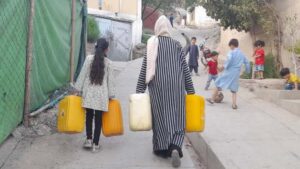
KABUL, Oct 1 2026 (IPS) - Drought has depleted wells, withered fruit trees, and reduced crop yields across Afghanistan. The heaviest burden of the water shortage falls on women in their daily lives, as they must fetch water from increasingly distant sources and use every single drop with extreme care.
More than half of Afghanistan is suffering from a prolonged drought and water shortage. The situation is critical in 19 provinces. Authorities predict the crisis will worsen. For instance, the capital, Kabul, is projected to lose the majority of its groundwater by 2030. In the northern province of Faryab, 90 percent of the area is already affected by drought.
Drought affects every aspect of her life. She struggles daily to secure enough water for her family’s needs. As an orchardist, she watches helplessly as the trees she has tended for years slowly wither and die while still standing
Water scarcity and poor harvests are further exacerbating Afghanistan’s food crisis. According to the UN World Food Programme, as many as 17.4 million people are in urgent need of food assistance.
Wells, springs, and groundwater sources are drying up. In some households, the water level in wells has dropped from 20 meters to 40 meters. On farmlands, water must now be drawn from depths of up to 120 meters, whereas previously it was accessible at 20 meters. Water is being rationed, and in some areas, farmers receive water for only 20 minutes a day.
When Afghanistan’s wells run dry, women’s workload increasesIn Logar province, near Kabul, drought and water shortages have damaged crops and caused fruit trees to wither. Women must walk increasingly long distances to fetch water for their families.
“When our well ran dry, my immediate concern was whether there would be enough drinking water for our children. I only wash clothes if there is drinking water left over. Sometimes I go several days without doing laundry. I also gather the dishes from three meals and wash them all at once to save water,” says 35-year-old Simin Gul (name changed).
The well belonging to her family of nine ran dry four years ago. The nearest water source is less than a half an hour’s walk away.
At times, Simin Gul and her neighbors are forced to buy water. The local piped water network supplies water only two days a week, and even then, only for a few hours at a time.
Families help one another and take turns collecting water in large containers, but even that is not enough for large families.
The wells around Simin Gul’s home have dried up one by one. Women suffer from back pain and other ailments from carrying heavy water containers from distant sources.
Fetching water is particularly difficult during menstruation. Women must fetch water even when they need rest. At times, children have to miss school to help their mothers carry water.
Water scarcity and poor water quality also cause hygiene and health problems for families.
“The tanker trucks have plastic tanks, and the trucks travel from street to street under the scorching sun. Our children have fallen ill from this water several times,” says Simin Gul.
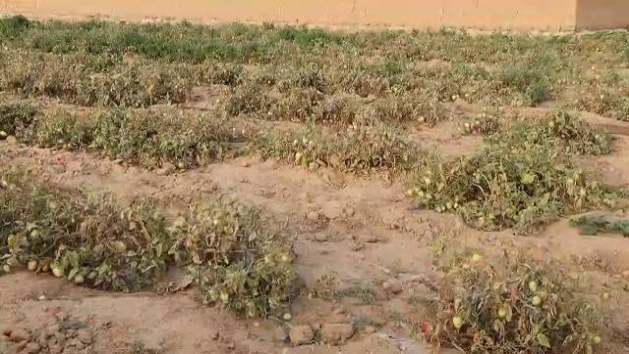
Drought-damaged crops in Logar province, near Kabul, where water shortages have reduced harvests and caused fruit trees to wither. Credit: Learning Together.
Water scarcity has also changed the daily life of 50-year-old Zarmina (name changed). She has lived and worked on her orchard for about 20 years. Her husband is also a farmer.
“This year, about 50 of my apple and apricot trees dried up. I’ve managed to keep the remaining hundred trees barely alive thanks to a spring. But both the yields and the fruit are smaller and of poorer quality.”
“Some farmers pay for irrigation, but we can’t afford it. My husband lost his tomato crop this year because tomatoes need a lot of water,” Zarmina laments.
Zarmina’s husband farms an area of about 60 acres. This year, he planted only half of it because of the water shortage.
“The wealthy can have deep wells dug. The fields of the poor remain dry,” Zarmina notes.
However, according to her, the problem is not just a lack of water but also inadequate infrastructure.
“Some areas have a piped water system. We should have one too, and the government ought to repair the irrigation canals as well. The problem is that Afghanistan has water, but it isn’t distributed efficiently,” she continues.
Zarmina is sometimes forced to buy drinking water, as her own well has very little water, and what remains is salty. Unless the authorities do something about the water shortage, the result will be a disaster, Zarmina believes.
Drought affects every aspect of her life. She struggles daily to secure enough water for her family’s needs. As an orchardist, she watches helplessly as the trees she has tended for years slowly wither and die while still standing. Together with her husband, she mourns the loss of productivity in their fields, where crop yields have dwindled because of the drought.
For Zarmina, water scarcity means more than just the drying up of springs; it means jeopardizing an entire livelihood and way of life, as well as constant worry about her children’s access to water.
As drought worsens, life in Kabul revolves around waterWater scarcity affects the capital, Kabul, too, even just a stone’s throw from the former presidential palace.
Sixty-year-old Shazia (name changed) lives in western Kabul. A large part of her week is spent securing water for her family of five.
To meet their daily needs, families either buy water or wait for the local communal tap to start running. Water used to flow every few days, but now the wait can be much longer.
When the water finally arrives, large containers and buckets are filled, and as much as possible is stored.
“Our lives revolve around water. We buy different types of water for different needs: bottled water for tea, filtered water for cooking, and tap water for washing and the toilet,” Shazia says.
Sheila lives on one of the hills in western Kabul. Together with her young daughter, she tries to find enough drinking water for her six children.
In Sheila’s neighborhood, some homes are connected to a private water supply system that delivers water every two days. Those who cannot afford it buy their water. Another option is to carry water uphill to their homes in heavy containers.
Before water flows properly from the taps of households connected to the private system, it must be allowed to run from the main street pipe for a few minutes. When nearby residents see the water flowing, they rush to the spot with their jerry cans.
“If we’re lucky, we manage to fill a few containers. Here, next to the presidential palace, we aren’t looking for a gushing water source anymore. A few drops for our children are enough for us,” Sheila laments.
“Aid organizations used to install water pipes, but no one comes to help anymore. We’ve been left here with empty jerry cans and thirsty children.”
Excerpt:
The author is an Afghanistan-based female journalist, trained with Finnish support before the Taliban take-over. Her identity is withheld for security reasons