

DENVER, Colorado, USA, Oct 21 2026 (IPS) - If you’ve been around Venezuelans for long enough, you know that we tend to speak in superlatives. We have the best baseball players, the most beautiful beaches, the tastiest arepas, and the wickedest dictators. But even being used to the scale of our superlatives didn’t quite prepare me for what I read in the May 5 edition of The New York Times, in a story called “In Venezuela, Trump Vowed to Show Accountability. Oil Deals Linger.” The story tells us that a network of shell companies controlled by Carlos Malpica (who is widely believed to be Maduro’s bagman) embezzled $11 billion of the country’s oil wealth in 2021 and 2022. In the Times’ words: “for every two dollars that Venezuela earned selling oil earlier this decade, one dollar was stolen, internal documents and official statistics show.”

Francisco R. Rodríguez
However, it is one thing to document the practice of corruption and another to argue that half of the country’s oil revenues were stolen. That conclusion is inconsistent with what we know about flows of currency into and out of Venezuela. Put simply, $11 billion of oil revenues could not have been stolen because if they had, Venezuela would not have been able to buy the goods that we know it purchased from the rest of the world.
The claim that half of oil revenues in 2021–22 were lost to corruption rests on a specific assumption: that if Venezuela’s state-owned oil company did not receive direct payment for its exports, the money must have been stolen. That interpretation misses one important fact. During this period, Venezuela was highly sanctioned, could not access bank accounts, and was paying for many of its imports directly with oil. That PDVSA did not directly receive cash payment on billions of dollars in receivables is not evidence of corruption; it is evidence of barter.
The mother of all kleptocracies
The claim that $11 billion were stolen is staggering because it would represent by far the largest corruption scandal ever uncovered. To take one example: the largest ever kleptocracy investigation, that for Malaysia’s 1MDB scandal, has been alleged to have diverted $4.5 billion over a seven-year period in a country whose GDP was approximately $270 billion a year. That works out to about 0.2 percent of Malaysian GDP over that period. Were the New York Times’ $11 billion figure correct, it would represent roughly 8 percent of Venezuela’s GDP over the period — approximately 32 times the size of the Malaysian graft relative to its economy. And if you take into account that estimates suggest that every dollar of oil revenue generates about 4 dollars of non-oil activity, you would reach the conclusion that the costs of Maduro’s alleged corruption was around 40 percent of Venezuelan GDP — several orders of magnitude higher than the cost of corruption found in numerous quantitative cross-national studies (and that[s even without counting the money other people were stealing). This would make Venezuela by far the mother of all kleptocracies.
The Times’ $11 billion number, if true, has major implications for the debates about Venezuela. For a long time, proponents of maximum pressure sanctions have argued that we shouldn’t worry about their detrimental effect on the country’s economy because the real cause of Venezuela’s collapse is corruption. That argument has always been strongly flawed: there’s no reason why corruption, mismanagement, poor policies and sanctions can’t all have contributed to the collapse. That said, if it were true that half of Venezuela’s oil income was being brazenly stolen, then the idea that external constraints are at most a secondary cause of Venezuela’s economic malaise acquires a greater ring of truth.
Reality check
Yet the story that Maduro’s henchmen stole $11 billion has a deep problem. If that money had really vanished, then Venezuela would not have been able to pay for the goods that it imported in those years.
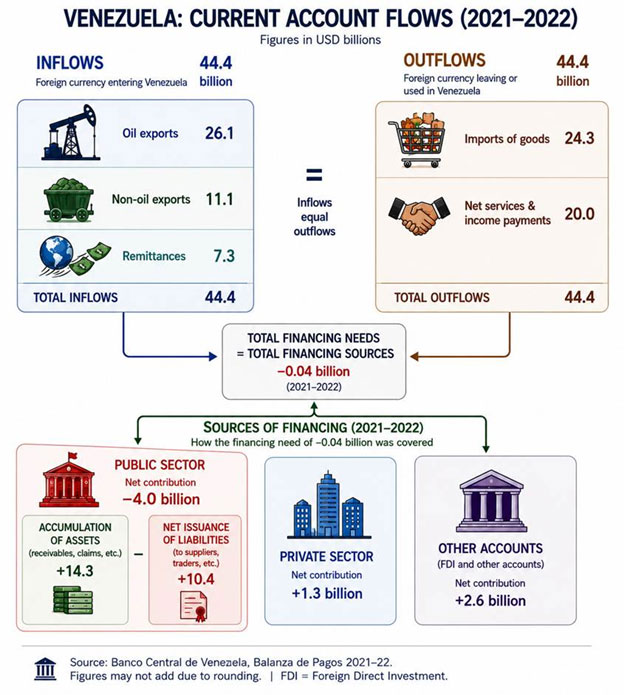
In 2021 and 2022, Venezuela sold $26 billion in oil shipments, or an average of $13 billion a year. In addition, it generated another $11 billion in non-oil exports, of which a large part is mining, and received around $7 billion in remittances. That means the country received total foreign currency inflows of $44 billion in those two years. Now here’s the rub. We also know that the country was paying around $44 billion in imports of goods, services, and income payments to the rest of the world over the same two years. In fact, for 2021 and 2022 combined, the country’s foreign currency revenues exceeded its spending by just $0.04 billion. This difference, also known as the current account balance, was essentially zero. It means the country was spending as much money as was coming in, which makes sense for a country that had no assets to run down and no one to lend it money.
In sum in 2021–22, Venezuela was living paycheck to paycheck. And when you’re doing that, it’s very hard for half of your paychecks to go missing without you and everyone around you noticing.
Table 1: Venezuela Current Account Statistics, 2021–2022
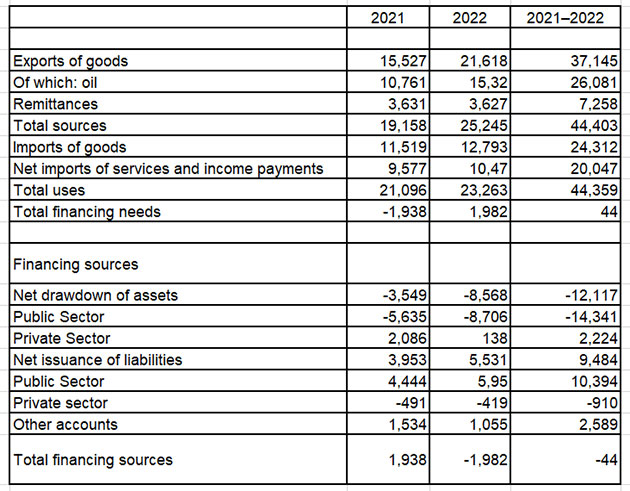
Source: Own construction using balance of payments data from Venezuelan Central Bank.
Now you might say: wait a minute, if the money was stolen, then maybe it didn’t come in at all, and instead of those $44 billion we would have had $55 billion in foreign currency earnings. Except that the New York Times story tells us that the oil was sold and invoiced, and that PDVSA never directly received payment for it. But if that’s true, then we know they must have been registered as exports. That’s how balance of payments statistics are built: you count an export when it is sold and invoiced, not when it is paid for.
But what if the Central Bank is lying? What if it’s just claiming that Venezuela sold $26 billion in oil to hide evidence of the corruption? Or what if it’s inflating import numbers with the same purpose?
Certainly, that would not be beyond them. And, in fact, we know there are circumstances under which over-invoicing of imports distorts balance of payments statistics. But that tends to happen in different conditions — for example, when there are exchange controls and people claim to be importing more than they really are.
To check this, I put together data reported by Venezuela’s 31 most important trading partners. Scaling up to the economy’s total trade, I estimate total goods imports of $23 billion for 2021–22, quite close to the Central Bank’s $24 billion.[1] I also looked at estimates of exports from physical oil shipments constructed by independent agencies.[2] Again, the numbers match up with what the Central Bank is telling us.
Francisco R. Rodríguez is a senior research fellow at the Center for Economic and Policy Research (cepr.net) in Washington, DC and a professor and fellow at the University of Denver’s Korbel School of International Studies.
[1] The calculation assumes that the share of trade with these partners remained stable between 2012 and 2021.
[2] Average oil exports from Venezuela in 2021 and 2022 were 627,000 and 616,500 barrels per day, respectively, according to data from Reuters and Refinitiv Eikon. Using these export volumes, the BCV’s implied sales price for Venezuelan oil would be $47.0 and $68.1 per barrel in 2021 and 2022, respectively, implying a discount of 10 percent on average relative to OPEC’s Merey price for those years. This is consistent with evidence that Venezuela sold some of its oil at a lower price than that of the market reference reported to OPEC (see, e.g., this story based on internal PDVSA reports and this New York indictment in a corruption case with direct numbers reflecting discounts on PDVSA sales). For Venezuela to have had a sizable current account surplus, the BCV would have to be understating its oil exports — but this would imply either substantially higher export volumes than those calculated by Reuters/Refinitiv Eikon based on tanker loading data, or that Venezuela was selling its oil at a substantially higher price. Both appear highly implausible.
IPS UN Bureau