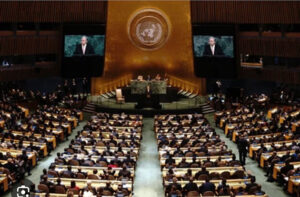
VICTORIA, Seychelles, Oct 28 2026 (IPS) - On 21 September 1976, less than three months after independence, Seychelles took its seat in the General Assembly of the United Nations. We became the 145th member of the Organisation. For a young nation of scattered islands in the Indian Ocean, with a small population and no army to speak of, it was far more than a ceremony. It was a promise that, in the family of nations, size would not decide whose voice was heard.
Fifty years later, I still believe in that promise. But I also know that it has never been kept automatically. It has to be renewed by every generation of leaders, and it now faces one of its hardest tests.
On 24 October, the United Nations marked its 81st anniversary. In his final United Nations Day message as Secretary-General, António Guterres reminded the world that the UN is not only an organisation but an idea: that humanity’s future depends on our ability to work together to advance peace, development and human rights.
Those words land at a sobering moment. Wars continue in several regions, often with civilians paying the highest price. The climate crisis is accelerating faster than our responses to it. Inequality is widening within and between nations. New technologies are advancing more quickly than our ability to govern them. And the UN itself is under severe financial strain, while its Security Council is too often paralysed by the very powers entrusted with keeping the peace.
It is in this climate that the Security Council is now deliberating, through its private straw polls, on who should become the tenth Secretary-General when Mr Guterres’s term ends on 31 December. For small island states, it matters more than most people realise.
Why should a small island care so deeply about who leads the United Nations? Because for nations like ours, multilateralism is not a matter of preference. It is a matter of survival.
We will never be the largest economies or the strongest military powers. Our protection has always been the rule of law, the strength of partnership and a seat at the table where every nation, large or small, has one vote. When the rules hold, a nation of just over 100,000 people can stand beside a nation of a billion and be heard. When the rules weaken, the small are the first to be pushed aside.
The UN has given small states some of their greatest achievements. The Law of the Sea gave island nations sovereign rights over vast ocean territories. The Paris Agreement set the aim of limiting warming to 1.5 degrees, a line that small islands fought hard to draw. And in January this year, the High Seas Treaty entered into force, bringing nearly two thirds of the world’s ocean, for too long a lawless frontier, under a framework for conservation and shared benefit. None of these would have been possible without the patient, often frustrating, work of multilateral diplomacy.
Yet I will not pretend the system is working as it should. A Security Council designed for the world of 1945 does not reflect the world of 2026. Africa, home to more than a quarter of the UN’s members, still has no permanent seat. Climate finance promised to vulnerable nations arrives slowly, in complicated forms, and often as loans that deepen debt.
The answer to an imperfect system of cooperation, however, is better cooperation, not less.
So what should the world, and especially its smaller nations, ask of the next Secretary-General?
First, courage. The Secretary-General has no army and a limited budget. The office’s greatest power is moral authority: the willingness to speak plainly to the powerful, to name injustice and to stand with those who have no other platform.
Second, the ability to build bridges. In a world divided between rival blocs, the UN’s leader must be trusted in Washington and Beijing, in Moscow and Brussels, but also in Victoria, Suva and Port Louis. Small states, which cannot afford permanent enemies, understand this better than most.
Third, a commitment to put the climate and the ocean at the centre of global security. For island nations, rising seas, coral collapse and extreme storms are not distant environmental issues. They are threats to our existence. In October, the International Union for Conservation of Nature warned that 96 percent of the world’s shallow-water coral reef ecosystems face an extremely high risk of collapse by 2075. Here in Seychelles, October storms have reminded us how fragile our coastlines and communities are. The next Secretary-General must treat the health of the ocean as the foundation of peace, food security and prosperity, and must ensure that the High Seas Treaty moves quickly from text to action as its first Conference of the Parties approaches.
Fourth, reform that people can feel. That means more than reorganising departments in New York. It must mean a fairer Security Council, a financial architecture that rewards resilience instead of punishing vulnerability, and a UN that delivers on the ground, where families, farmers and fishers live.
There is also a question of history. In 81 years, the United Nations has never been led by a woman. Without favouring any candidate, I believe it is time for the Organisation to show, at its highest level, the equality it rightly asks of its members.
Fifty years ago, Seychelles came to the United Nations as one of its smallest members, full of hope. We came because we believed that the ocean which surrounds us connects us to the world rather than isolating us from it. That belief has not changed.
The next Secretary-General will inherit a divided world and a weary institution. But they will also inherit the most important idea humanity has ever agreed upon: that our future is shared, and that no nation, however small, should face it alone.
Dialogue over division. Cooperation over confrontation. Solidarity over fear. Those words deserve to be more than a message for one day in October. They should be the test of the next ten years.
James Alix Michel is a former President of Seychelles, a Blue Economy pioneer and a champion of ocean protection.
IPS UN Bureau