
SUVA, Fiji, Nov 4 2026 (IPS) - The Pacific Ocean connects thousands of islands, and understanding how ocean acidification is unfolding across the region requires more than individual research projects or monitoring stations.
Scientists need observations from different island environments, collected over time, to understand how seawater chemistry is changing and what those changes could mean for marine ecosystems and the communities that depend on them.
The work is being strengthened through regional collaboration, with Pacific scientists sharing data, technical knowledge and research experience to build a more complete picture of a changing ocean.
Dr Katy Soapi, Pacific Community (SPC) Coordinator for the Pacific Community Centre for Ocean Science and a Pacific scientist, says the broader scientific community is aware that ocean chemistry is changing. The priority is now building local evidence to understand how those changes may affect different island environments.
“What Pacific scientists are now doing is building the local evidence needed to understand how those changes may impact our different island environments,” Soapi said.
“At many of our monitoring sites, we are seeing considerable natural variability in pH over days, months and seasons, which is normal,” she said. “It is important to capture this data over time because coastal waters are influenced by temperature, rainfall, freshwater inputs, biological activity, land-based pollution and local oceanographic conditions.”
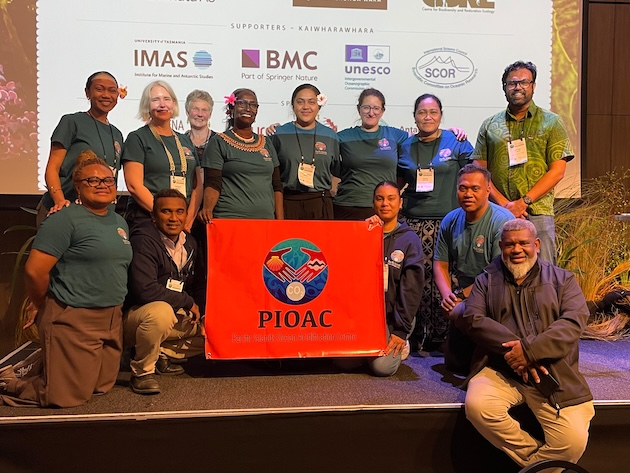
PIOAC members with Salesa Nihmei from SPREP and a representative from the Asian Development Bank (ADB) at the 6th International Symposium on the Ocean in a High-CO₂ World, Tākina Wellington. Credit: SPC
Monitoring programmes are at different stages across the region. Fiji has an established programme, with monitoring in the Suva area since 2023 and data that contribute to Sustainable Development Goal 14.3.1 reporting.
Samoa has received support through access to monitoring equipment, training and technical advice, while the Solomon Islands programme is newer, with scientists from Solomon Islands National University receiving regional and in-country training as they establish the technical capacity for long-term monitoring. Kiribati and Papua New Guinea also have their own monitoring histories and research priorities.
These differences matter when comparing observations across the Pacific.
“This variation is important; a harbour in Fiji, a lagoon in Kiribati, coastal waters in Samoa or reef environments in Solomon Islands and Papua New Guinea can experience very different combinations of temperature, rainfall, freshwater input, current, biological activity and human pressure,” Soapi said.
“The Pacific is connected, but it is not environmentally uniform.
“This is why local monitoring is important and why we cannot rely solely on regional or global averages.”
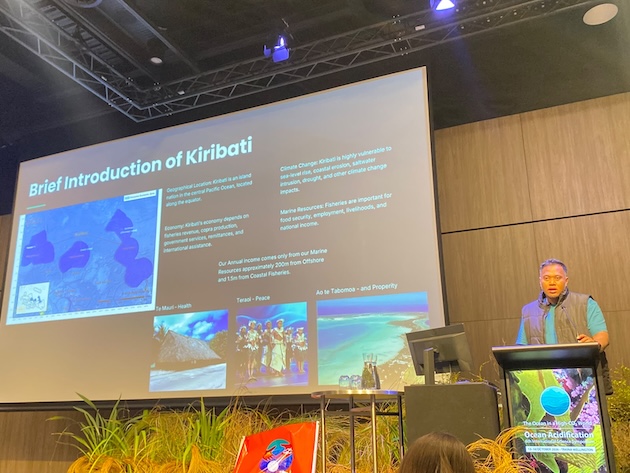
Manibua Rota from the Ministry of Fisheries and Ocean Resources (MFOR), Kiribati, presents on ocean acidification monitoring in Kiribati at the 6th International Symposium on the Ocean in a High-CO₂ World, Tākina, Wellington. Credit: SPC
Connecting the Science Across the Pacific
The Pacific Islands Ocean Acidification Centre (PIOAC), established in 2021, supports efforts to connect national monitoring programmes and strengthen scientific capacity across the region.
The Centre brings together the SPC, the University of the South Pacific, the University of Otago and Earth Sciences New Zealand, formerly NIWA.
PIOAC’s work spans the Pacific, through joint work and ongoing discussions with nine Pacific Island countries and territories: Fiji, Papua New Guinea, Solomon Islands, Vanuatu, Tuvalu, Kiribati, Samoa, Tokelau and New Caledonia.
Its work includes providing monitoring equipment, technical advice, training, sensor troubleshooting, data management and quality assurance. It also connects Pacific researchers with international monitoring networks and supports countries in contributing data to regional and global reporting processes.
For scientists working in small teams across geographically dispersed islands, this support helps build the technical capacity needed to maintain monitoring programmes and generate reliable data over time.
Azaria Pickering, an ocean monitoring and technical officer at SPC in Fiji, says regional cooperation has changed how scientists approach monitoring.
“We’ve moved from monitoring our waters as individual countries to building a collective understanding of what’s happening across our Pacific Ocean,” she said.
“Through the Pacific Islands Ocean Acidification Centre and regional partnerships, we’ve created a community where knowledge is shared and challenges are solved together.”
She said the use of common equipment, methods and training was helping countries strengthen their monitoring programmes at home.
“We’re beginning to close critical data gaps across the region and use that evidence to engage our governments, shape national priorities and bring the Pacific’s experience of ocean acidification into global conversations, including at COP.”
For Dr Aleluia Taise of the National University of Samoa, the research is closely connected to the future of Pacific communities.
“As Pacific Islander marine scientists, we believe it is our responsibility as citizens and custodians of the Pacific Ocean to address priority issues affecting our livelihoods and wellbeing,” she said.
Taise says there remains a critical lack of scientific evidence needed to understand the effects of ocean acidification on coral reefs and coastal ecosystems.
“Research must be supported by stronger institutional backing, policy alignment and collaboration with regional and international partners to ensure it can continue.”
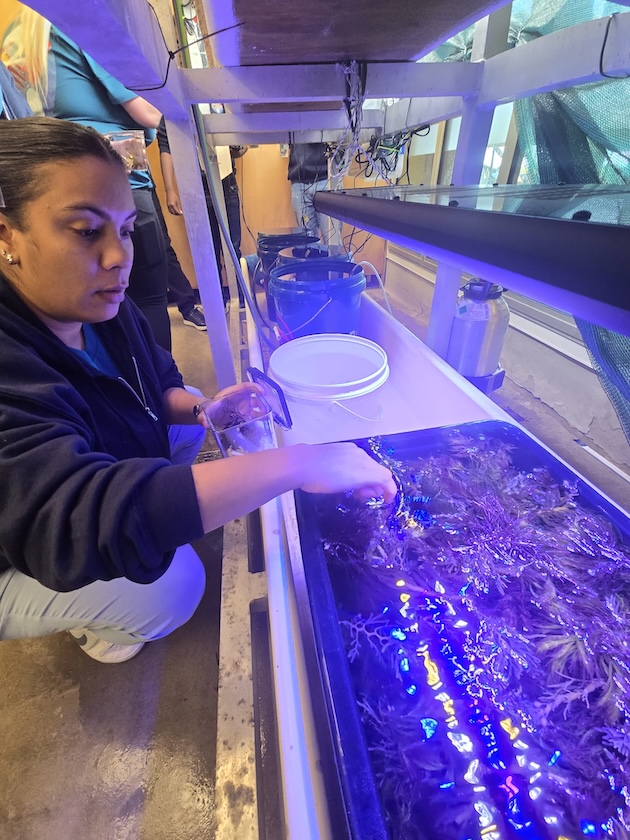
Azaria Pickering from SPC selects macroalgae from the holding tank for the biological incubation tests during PIOAC training at the Victoria University of Wellington Coastal Ecology Lab (VUCEL). Credit: SPC
From Measuring Seawater to Understanding Marine Life
While monitoring seawater chemistry provides information about changing ocean conditions, scientists also need to understand how these changes affect marine organisms.
This is the next area of research being developed by Pacific scientists.
In Wellington, scientists from Fiji, Samoa, the Solomon Islands and Kiribati took part in biological experiments training from 5 to 9 October, gaining practical experience in studying how marine organisms respond to ocean acidification and higher temperatures.
The training is intended to strengthen research connecting changes in seawater chemistry with their potential effects on corals, shellfish and other marine organisms.
Soapi said biological research would help scientists develop studies around locally important species and better understand the implications for reefs, fisheries and livelihoods.
“Monitoring seawater chemistry tells us how conditions are changing, while biological research helps us understand what those changes could mean for the organisms that support our reefs, fisheries and livelihoods,” she said.
For Dr Lindon Havimana of Solomon Islands National University, the research is also about ensuring scientific knowledge reaches communities before the impacts become more pronounced.
His interest in ocean acidification research stems from a responsibility to understand, anticipate and communicate changes taking place in the ocean and to consider how communities can prepare for a threat whose impacts may not yet be fully visible.
“I believe that the greatest value of science lies not only in understanding environmental change but also in ensuring that knowledge reaches people early enough to make a difference,” Havimana said.
“As scientists, we have a responsibility to bridge the gap between scientific discovery and community preparedness, transforming evidence into awareness, awareness into action, and action into resilience.”
He said the implications extended beyond ocean chemistry to the health of marine ecosystems, coastal fisheries, food security and the continuation of traditional practices.
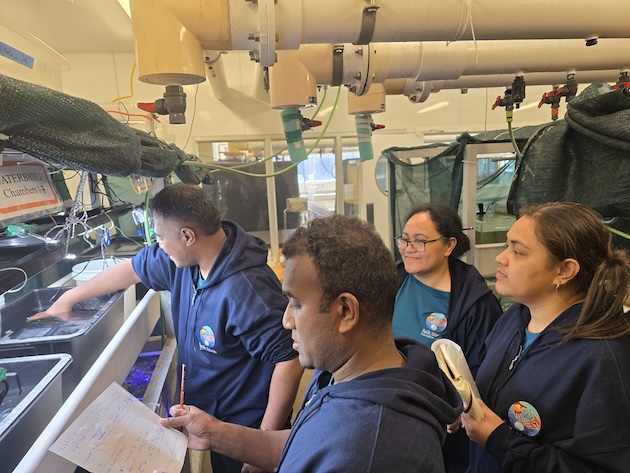
Participants from Samoa, Kiribati and Solomon Islands remove their monitored species after a 30-minute incubation at different pH and temperature conditions on Day 1 of the experiment during PIOAC training. Credit: SPC
Taking Pacific Research to the International Stage
These regional efforts were represented at the sixth International Symposium on the Ocean in a High-CO₂ World, held in Wellington, New Zealand, from 13 to 16 October.
The symposium brought together the international scientific community under the theme Moving from Understanding to Action using Multiple Knowledge Systems.
Discussions examined ocean acidification alongside ocean warming, deoxygenation and other pressures affecting marine ecosystems, with a focus on strengthening scientific understanding and connecting research with action.
For Pacific scientists, participation provided an opportunity to present regional research, exchange knowledge and strengthen relationships with the international scientific community.
It also highlighted the challenges facing island countries, including limited monitoring coverage, equipment maintenance, technical expertise and sustained funding.
Dr Kim Currie, an ocean acidification consultant working with SPC, said access to scientific resources differed across Pacific countries.
“Some countries like Fiji, Samoa and the Solomon Islands have the resources to do the careful measurements that are needed, but other countries do not yet have the scientist and equipment necessary to do this work,” she said.
“Working with regional and overseas partners to share knowledge and skills is one important step towards understanding how the Pacific Ocean will cope in the future.”
For Soapi, the importance of that support is also shaped by her own experience as a researcher.
Reflecting on her early work in ocean acidification, she recalled the challenges of deploying monitoring equipment and working in a field where regional scientific support was limited.
“I had received training, but I was nervous about deploying equipment – this was all part and partial of being isolated and being new in a field,” she said.
That experience has stayed with her and influenced her commitment to supporting other Pacific scientists, particularly those working in small teams across large distances.
“For me, coming together means building a Pacific community of scientists who can support each other, share knowledge and collectively understand the changes taking place across our ocean.”
The work underway across the region is still developing. More monitoring, biological research, technical training and sustained support are needed to strengthen the evidence available to Pacific countries.
But by connecting national research programmes and bringing scientists together, the region is building a stronger foundation for understanding ocean acidification.
The aim is not to produce one picture of the entire Pacific but to bring together the different observations and experiences that explain how a changing ocean is affecting individual islands, ecosystems and communities.
IPS UN Bureau Report



Excerpt:
From Fiji and Samoa to the Solomon Islands, Kiribati and Papua New Guinea, Pacific scientists are connecting research, monitoring and expertise to better understand how changing ocean chemistry is affecting the region's marine environments.