

PORTLAND, USA, Nov 5 2026 (IPS) - Approximately 110 countries, including the United States, have fertility rates below the replacement level of 2.1 births per woman.
In 2025, the U.S. fertility rate fell to a historic low of approximately 1.6 births per woman, extending a long-term downward trend that began in 2007 when the rate was still well above the replacement level of 2.1 births per woman (Figure 1).
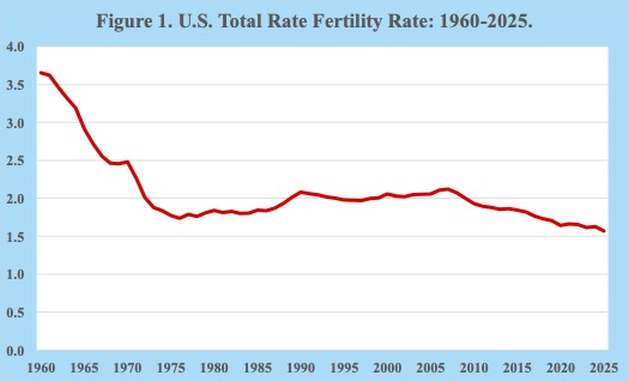
Source: U.S. National Vital Statistics Report.
The decline in U.S. fertility to well below the replacement level has raised serious concerns among government officials, economic advisors, and business leaders. It has prompted two key questions: What is causing the low fertility rate in the United States, and what can be done to increase fertility?
As is the case in many other countries, the low fertility rate in the United States reflects a combination of economic, social, and cultural factors. These include rising living costs, financial uncertainty, declining marriage rates, greater control over pregnancy, a shortage of suitable partners for starting families, delayed childbearing, increasing childlessness, and fewer teenage pregnancies.
The historic low fertility rate in the United States of approximately 1.6 births per woman is unlikely to return to the replacement level of about 2.1 births per woman any time soon. As deaths are expected to outnumber births around 2040, immigration will play an increasingly important role in shaping the country’s demographic future. Without immigration, the U.S. population could experience a substantial decline by the end of the century
Given the strength and complexity of these factors, the U.S. fertility rate is unlikely to return to the replacement level of about 2.1 births per woman anytime soon.
Another contributing factor to the low fertility level is the high cost and limited availability of child care, which often makes it difficult for many parents to balance work and family responsibilities. In 2023, two-thirds of U.S. parents with young children spent at least 20% of their household income on child care.
The decline in teenage childbearing has also contributed to lower fertility. Since 1991, the teenage fertility rate has declined by 81 percent, reflecting factors that include improved access to long-acting, reversible contraception and expanded public health education. Whereas in 1991 teenage childbearing accounted for 13% of U.S. births, by 2025 the proportion had declined to approximately 3%.
Another possible factor is the widening educational and social gap between young U.S. men and women. Boys are falling behind girls in educational achievement and some measures of the transition to adulthood. For example, approximately 47% of U.S. women ages 25 to 34 have a bachelor’s degree, compared with 37% of U.S. men. These differences may affect relationship formation, making it more difficult for some women to find compatible partners and potentially delaying marriage and childbearing.
As young women surpass men in educational attainment in the U.S., some report difficulty finding partners with similar educational backgrounds and values. Other concerns include emotional compatibility, a limited pool of similarly educated men, and a dating culture that places less emphasis on long-term commitment.
Greater financial independence has also given women more freedom to decide whether and when to marry and have children. At the same time, some men struggle to establish careers and achieve financial stability, potentially creating mismatched expectations among prospective partners. Many women are also prioritizing education and careers and are less willing to enter relationships they do not consider suitable for long-term partnership and parenthood.
Women in the United States are also having children later in life. In 2023, the average age at which women had their first child reached a record high of nearly 28 years, reflecting a steady multi-decade climb from 22 years in 1960.
This shift reflects several factors, including higher educational attainment, career development, and greater access to contraception. First births among women aged 35 and older have increased, while births to women under 25 have declined, reflecting a growing tendency to delay motherhood.
Childlessness among U.S. women has increased across nearly all reproductive age groups, particularly among women in their 20s and early 30s. Approximately 40% of 30-year-old women in the United States are now childless, compared with around 18% in 1976 (Figure 2).
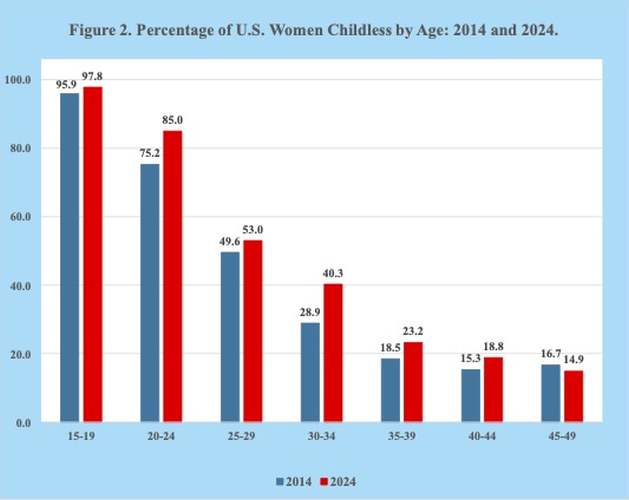
Source: U.S. Census Bureau.
The current U.S. administration’s efforts to raise the country’s low fertility rate are unlikely to reverse the downward trend. Relatively small financial incentives alone are unlikely to overcome the broader economic, social, and personal factors influencing decisions about childbearing.
The administration’s efforts are modest compared with the pronatalist programs adopted by many other low-fertility countries, which have had limited success in raising birth rates. Moreover, the underlying factors keeping U.S. fertility well below the replacement level are unlikely to be adequately addressed by the country’s current administration and will probably persist for years to come.
With fertility remaining low, deaths in the United States are projected to outnumber births around 2040, with the gap widening thereafter. By 2080, the Census Bureau projects that annual deaths will exceed births by approximately one million (Figure 3).
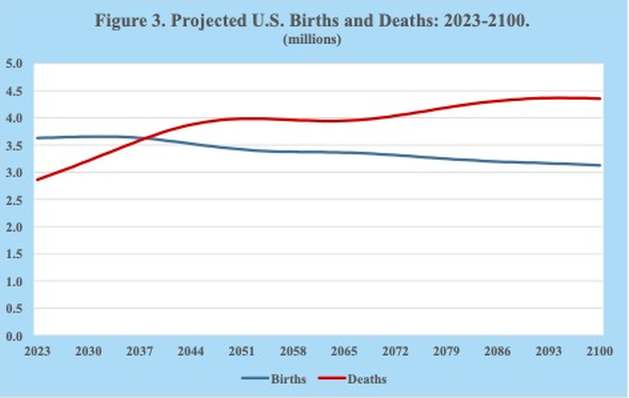
Source: U.S. Census Bureau.
Immigration, however, is expected to sustain population growth, bringing the U.S. population to nearly 370 million by 2080. Without immigration, the Census Bureau projects that the country’s current population of 343 million would begin declining in about 15 years and fall to roughly 226 million by 2100.
In conclusion, the historic low fertility rate in the United States of approximately 1.6 births per woman is unlikely to return to the replacement level of about 2.1 births per woman any time soon. As deaths are expected to outnumber births around 2040, immigration will play an increasingly important role in shaping the country’s demographic future. Without immigration, the U.S. population could experience a substantial decline by the end of the century.
Joseph Chamie is a U.S. consulting demographer, a former director of the United Nations Population Division, and the author of numerous publications on population issues.