
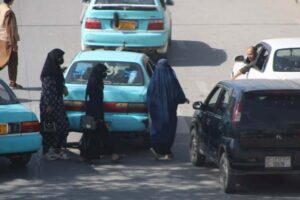
KABUL, Nov 6 2026 (IPS) - In Afghanistan, the Taliban are detaining women, even when they are wearing a hijab. Activists suspect that the issue of attire is merely a pretext used by the Taliban to hunt down critics of the regime.
For women, Kabul is a city of fear. Whether they are heading to the doctor, the shops, or to visit relatives, reaching their destination is never certain.
They fear checkpoints, the Taliban’s “morality police,” and the risk of being detained for wearing the “wrong” clothing or for lacking a male escort.
These arrests are just a pretext. The Taliban are rooting out women who speak out against them. When they arrest women, they search their phones. If they find even the slightest hint of something suspicious, only God knows when that woman will be released
For many women, leaving the house is a difficult decision. They are forced to consider what might happen if they are detained: Will I be able to return home? And if I do, will I still hold the same position within my family or community?
According to Amu TV—an Afghan media outlet based in the United States—the Taliban’s morality police detained at least twenty women and girls in the Taimani neighborhood of Kabul in September.
Some of those detained reported that they were taken into custody despite wearing a hijab in compliance with the rules; they also described how the police tore at their clothing during the altercation. Following an overnight detention, they were released only after their families and local communities paid bail.
Ahmad (name changed) is a street vendor in Taimani. She describes the arrest:
“I really don’t understand what they were after. All the women were wearing hijabs, yet they forcefully grabbed people indiscriminately —including a pregnant woman. Despite pleas, she was forced into a police vehicle.”
“There were many other women present who were dressed exactly the same way as those who were taken, and it was unclear why some were seized while others were left behind. People were too afraid to ask. The Taliban beat the women before taking them away. Who knows what they might do to men?”
Even wearing a hijab may not prevent arrestMarzia (name changed) was detained on June 9 while on her way to a shop in the Pul-e-Surkh area. She was accused of being out illegally without a hijab.
“When they ordered me to get into their vehicle, I refused. They used derogatory language and threatened to force me inside if I didn’t agree to go voluntarily. Another woman was also forced into the vehicle, and we were taken to a police station.”
“They spoke to us abusively and said terrible things. Then, they told us to summon our male guardians. My father arrived, but no one listened to him. He brought other older men from our neighborhood to the scene. They promised to guarantee that I would not go out again without a hijab,” she recounts.
Marzia’s father had to pay a fine of 15,000 afghanis (approximately 200 euros) because she was not wearing a hijab. Only then was she allowed to return home.
Marzia stated that she was held for about six hours. The Taliban treated her as if she had committed a serious crime. “They treated me really badly. One of them said that it would be right to kill girls like me because we have turned against Islam. When they demanded my phone, I told them it contained personal photos. One of them replied: ‘You appear in public looking like that—why are you worried about the photos?'”
In Marzia’s view, there is nothing wrong with her attire. She was wearing a long, loose-fitting coat, a headscarf covering her hair, and a face mask. This was not enough for the Taliban. They claimed her hijab did not provide sufficient coverage and that she should be wearing a burqa.
Some women’s rights activists interpret the Taliban’s use of arrests not merely as a deterrent for those who defy dress codes, but also as a means to identify women who have criticized them.
Maryam, a female activist from Kabul, says that the Taliban are doing everything in their power to track down women who were activists under the previous government—or who remain so today.
“These arrests are just a pretext. The Taliban are rooting out women who speak out against them. When they arrest women, they search their phones. If they find even the slightest hint of something suspicious, only God knows when that woman will be released.”
Activists also note that fines are being used as a tool to curtail women’s freedom and confine them to their homes. At a time when many families struggle to secure even one nutritious meal a day, a sum of 15,000 afghanis to secure the release of a girl or woman is an enormous amount.
According to activists, the fear of arrest and the threat of financial penalties have led to stricter controls within families. Some families no longer allow women to leave their homes at all, while others inspect the women’s attire before permitting them to go out.
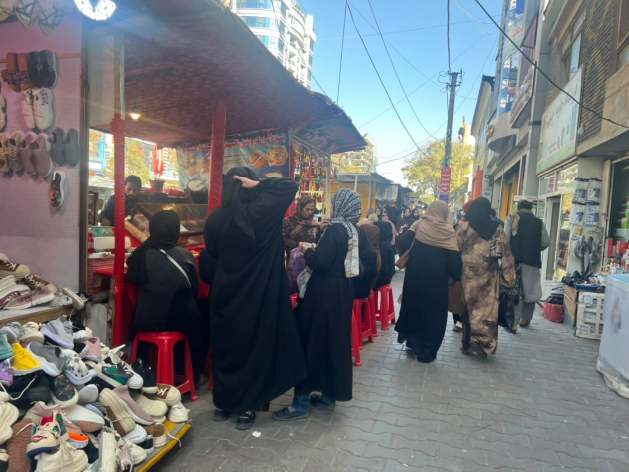
For many women, leaving the house is a difficult decision. Credit: Learning Together.
The Taliban have defended the arrests of women over their clothing. Saifuddin Khyber, a representative for the Taliban’s Ministry for the Promotion of Virtue and the Prevention of Vice, confirmed to Amu TV that women have been detained in Kabul and Herat. He considers the refusal to wear a hijab a serious offense.
According to Khyber, the Taliban view the wearing of a hijab by women as both a religious and a legal obligation. Muslim women are required to cover themselves completely, from their hair down to their toenails.
Article 13 of a Taliban law published in 2024 mandates that women must fully cover their faces and bodies. The same article prohibits the wearing of clothing that is thin, short, or tight-fitting.
Article 24 of the law grants the Taliban’s morality police the authority to punish those who violate the law. Penalties may include formal guidance, stern reprimands, fines, detention for a few days, or other sanctions—all of which can be imposed without a court hearing.
The Taliban are actively seeking out women who speak out against themIn June, women were detained in several provinces, including Balkh, Herat, and Takhar. In October 2026, the UN mission in Afghanistan, UNAMA, reported that it had received information regarding the punishment of at least 52 women in Kabul and Herat between July and September.
According to the UN, the arrests were prompted by the wearing of colorful headscarves or makeup, appearing in public with hair uncovered or without a concealing chador, or the absence of a male escort.
The Taliban restrict access to statistical data, making it difficult to obtain precise figures on the number of women who have been detained.
Fear among women in Kabul persists, even as some of those who were detained are released. Every time a woman steps outside, she must be prepared for the possibility that anything could happen.
Excerpt:
The author is an Afghanistan-based female journalist, trained with Finnish support before the Taliban take-over. Her identity is withheld for security reasons