
UNITED NATIONS, Nov 16 2026 (IPS) - Somewhere tonight, a family that lost its home to the water is asleep in a school gymnasium. The tent, the blankets and the first meal arrived within hours. But a secure home will take years. Every climate disaster ends with the same question, and few climate budgets have a line for it: where will we sleep tonight?
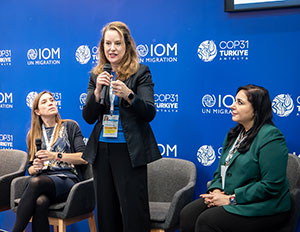
Amy Pope, Director General of IOM, at COP31 in Antalya, Turkiye. Credit: IOM
The scale is no longer in doubt. In 2025, disasters caused 29.9 million internal displacements – 13% above the ten-year average. Almost 13.6 million people were living in displacement caused by disasters at year’s end, 37% more than a year earlier.2 Climate is rarely the only force at work, and conflict and violence triggered more displacements than disasters last year.3 However, climate can deepen these pressures – and people displaced for any reason need somewhere safe to live. We track emissions and estimate disaster losses. But we need a clearer picture of how long families wait for a safe home.
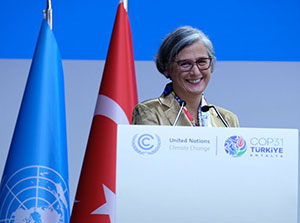
Anacláudia Rossbach, Executive Director, UN-Habitat, speaking at a High level Dialogue in COP31 in Antalya, Turkiye. Credit: UN-Habitat
We propose to give that gap a name and a number: time to home. It is the time between the day a family is displaced and the day it is living in a safe, affordable home with secure tenure – meaning protection against forced eviction – whether it chooses to return, settle where it is, or live elsewhere. Building on existing work on durable solutions to internal displacement, this measure would track one essential part of recovery. The idea is simple to grasp: make the wait visible, understand what prolongs it, and work to shorten it. Measuring that wait would bring together the expertise of our two organizations. IOM knows where people go and what they face on the way and where they first find shelter, as the agency that tracks displacement and co-leads the global Shelter, Land and Site Coordination Cluster. UN-Habitat knows what the land, the law and the city allow when they arrive. Working with governments and communities, we can build a clearer picture of the gap and what would help shorten it.
Behind the number lies a conviction we share. A safe home is a foundation for adapting to a changing climate and living with dignity. Without stable housing, people can face greater barriers to enrolling children in school, finding work, opening a bank account, or accessing support. Helping people stay safely, move safely, and find a secure home requires connected policies and investment.
At COP31 in Antalya, we ask governments for three commitments:
1. Put housing into adaptation plans. Include housing and secure tenure for people who stay and those who move in national adaptation plans and in the implementation of their Nationally Determined Contributions (NDCs) under the Paris Agreement, and adopt or pilot time to home among their indicators of progress. Where relocation is necessary, measure whether people have freely made informed decisions and can access safe housing, essential services and work.2. Fund the transition to a safe home. Bring adaptation finance and funding for loss and damage together with recovery and development finance to bridge the gap between emergency shelter and long-term housing. Work with local governments and community organizations, including in cities receiving displaced people, so that shelter is a first step toward a secure home. Track how this funding improves people’s housing and safety.
3. Plan for safe homes before a crisis. Where climate risks are known, identify suitable land and agree with communities on access, tenure and services. Prepare cities to receive people who need to move, so that they have safe options and support before a crisis forces them to leave. Invest in upgrading informal settlements, affordable housing and resilient infrastructure to help people stay safely wherever possible. Throughout these efforts, protect people against forced eviction.
We will not ask of others what we are not prepared to do ourselves. IOM and UN-Habitat are ready to work together to put time to home into practice: drawing on IOM’s displacement tracking and shelter operations and UN-Habitat’s urban and land data, we will work to measure it, and what each month of waiting costs, in selected cities and settlements, and to share what we learn openly, including whether land and tenure, rather than construction, are the longest part of the wait. We invite every government, city and partner that wants to shorten the wait to join us in Antalya.
As climate risks grow, people will continue to adapt where they live, and some will need to move. Everyone should have the chance to build a safe future wherever they live. Climate adaptation has an address. Let us make sure that everyone has one.
Notes and sources
1.- UN-Habitat estimate for 2024: about 1.16 billion people, or 24.8% of the global urban population, live in slums and informal settlements. UN-Habitat, Transforming informal settlements: Data, standards and practice, session summary, 13th World Urban Forum, Baku, May 2026.2.- Internal Displacement Monitoring Centre (IDMC), Global Report on Internal Displacement 2026: summary, May 2026. In 2025: 29.9 million disaster displacements, 13% above the decadal average; almost 13.6 million people displaced by disasters at year end, 37% more than at the end of 2024. The 13.6 million figure includes people displaced in earlier years who were still displaced at the end of 2025. The 29.9 million figure counts displacements (movements), which can include the same person more than once. Both figures cover all disasters, including geophysical hazards such as earthquakes, not only climate-related events. Full report: doi.org/10.55363/IDMC.ETWG8973.
3.- IDMC, Global Report on Internal Displacement 2026 (same source). In 2025, conflict and violence triggered a record 32.3 million displacements, more than the 29.9 million caused by disasters, the first time on record. IDMC counts displacements (movements), not distinct individuals.
Amy Pope is the Director General of the International Organization for Migration (IOM). Anacláudia Rossbach is the Executive Director of UN-Habitat.
IPS UN Bureau



Excerpt:
After a flood or other disaster, finding a safe home can take years. At COP31, we should commit to measuring – and shortening – that wait.