

ANTALYA, Türkiye, Nov 22 2026 (IPS) - COP31 ended without an overarching climate agreement on Sunday after two days of overtime, as deep divisions over fossil fuels, climate finance and global warming prevented nearly 200 countries from reaching consensus.
The European Union, the United Kingdom, Panama and other countries rejected the proposed Antalya Pact, arguing that it failed to respond adequately to the accelerating climate crisis.
UN Secretary-General António Guterres expressed his disappointment.
“I am deeply disappointed that COP31 has ended without consensus on an overarching outcome. I share the very profound frustration of all those who expected governments to rise to the moment the climate crisis demands.”
Five major disputes exposed the divisions that prevented an agreement.
“This setback does not change the facts. There may be no consensus in the negotiating room. There is no ambiguity in the science,” he said.
In the closing plenary, Ireland’s climate minister Darragh O’Brien, speaking for the EU, said, “It’s unconscionable that we would have a climate act that makes no reference to fossil fuels.”
Yamide Dagnet, Senior Vice President, International, at the Natural Resources Defence Council (NRDC), said, “This year COP closes with mixed signals and a negotiated outcome that failed to meet the moment. It’s a sharp contrast to real-world clean energy progress, driven by economics, security and health concerns.”
Dagnet said it was essential to accelerating electrification with clean energy. But the most disappointing was “climate financing, especially for adaptation and resilience, which remains woefully inadequate compared to the need. When elephants fight, the grass gets trampled—and that’s what happened here, with the world’s biggest economies failing to support developing countries. This is life-or-death support for the poorest and most vulnerable people around the world who are suffering the worst impacts of the climate crisis and have contributed the least to its cause.”
Responding to the closing of the COP31 climate summit in Türkiye today, Dr Jeni Miller, Executive Director of the Global Climate and Health Alliance, a consortium of more than 300 health professionals and health civil society organisations and networks from around the world addressing climate change, said, “The COP31 process has betrayed people’s health by failing to deliver a clear plan for transitioning away from fossil fuels or providing the finance countries need to protect lives and prepare their health systems for escalating climate shocks.”
Ambassador Peter Thomson, United Nations Secretary-General’s Special Envoy for the Ocean, noted that the “great majority of countries recognise that we cannot solve the climate crisis without protecting the ocean. They now have to act on that recognition. We know that aggressively cutting fossil fuel and methane emissions are the best things we can do to safeguard the ocean’s health. There is no investment more important than in transitioning away from burning fossil fuels to an equitably electrified world powered by renewable energy.”
Steven Guilbeault, former Canadian Minister of Environment and Climate Change, said the one glimmer of hope has been the recognition of the ocean in a way we’ve never seen at UN climate talks before. We’ve desperately needed these promises of an ocean-specific roadmap, new finance, and a ramping up of blue priorities in climate plans. It’ll carry us closer to protecting 30% of the ocean by 2030. The challenge now is to build on the progress made in Antalya and turn it into real action for the ocean, for nature and for the communities that depend on them.”
Bryan Bixcul, Just Transition lead, International Indigenous Peoples Forum on Climate Change (IIPFCC), said he was “deeply troubled by the level of dysfunction we witnessed in the UNFCCC process. In the same year that science warned we are on track to exceed the 1.5°C threshold, COP31 failed to face that reality head-on and name fossil fuels as the root cause of climate change. Antalya ends without its key deal, putting the interests of petrostates and fossil fuel lobbyists ahead of people, especially Indigenous Peoples. Our territories are on the frontline of this fight.
“If drilling continues, temperatures will keep rising, our waters will be contaminated and our lands destroyed. If the energy transition moves ahead without recognising our rights and without adequate finance, a new mining push will once again kill, destroy and set us back in the fight against climate change. There is no meaningful progress on the just transition mechanism, and no clarity on climate finance. How are we supposed to trust this process?”
Fatima Eisam-Eldeen, a fossil fuel researcher with the University of Barcelona, said, “No agreement is better than a bad agreement. Where this COP failed to come to a final decision, at least it kept false solutions from being validated through the negotiations. We must not waste more precious time and resources on derailing tactics, because for frontline communities, this is a life-or-death situation. The real solution is clear: we need to phase out fossil fuels fast, in a just and orderly manner, and for that, we need mechanisms.”
Eisam-Eldeen said it would now fall on Ethiopia to clean up the mess, “raise ambition and deliver for the people who need it today. It’s a sad but well-known phenomenon: the mess made by the states with wasted interest in continuing burning fossil fuels will be cleaned up by the people suffering its consequences.”
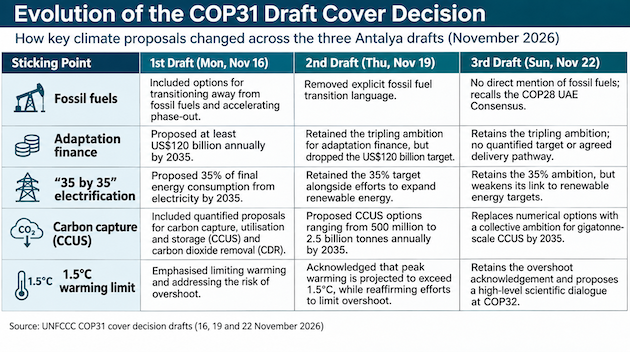
Credit: IPS/AI-assisted graphic. Data source: UNFCCC (2026).
Fossil fuels: The transition that disappeared
Saudi Arabia and other oil-producing countries opposed stronger commitments on fossil fuels, while a coalition of more than 130 countries pushed to reaffirm the COP28 agreement to transition away from oil, gas and coal.
Although the first draft included explicit transition language, subsequent versions removed it. The final proposed text recalled the Dubai agreement without mentioning fossil fuels, prompting strong objections from the EU and vulnerable countries.
Adaptation finance: The missing US$120 billion
Developing countries, particularly in Africa, pushed for stronger financial commitments to help vulnerable communities cope with worsening climate impacts.
An earlier draft proposed increasing annual adaptation finance to at least US$120 billion by 2035. The figure was subsequently dropped, leaving only an ambition to triple funding without a clear baseline or delivery plan.
With the cover decision rejected, even this proposed commitment was not adopted.
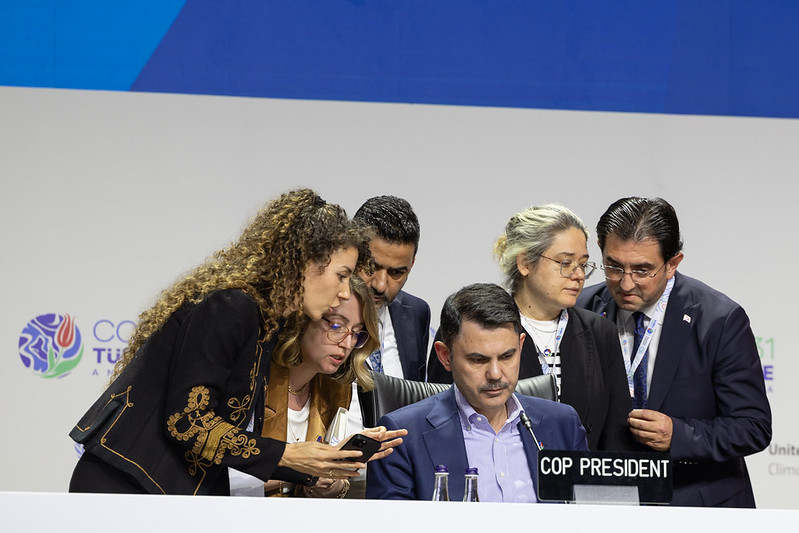
Delegates crowd around COP31 President Murat Kurum as the climate talks stretch on beyond the deadline. Credit Kiara Worth/UN Climate Change
The 1.5°C threshold: A world heading towards overshoot
The proposed agreement acknowledged that global warming is projected to exceed the Paris Agreement’s 1.5°C threshold but offered limited new measures to address the threat.
It also promoted carbon capture technologies, proposing gigatonne-scale deployment by 2035. Critics warned that reliance on these technologies could distract from urgent emissions reductions and prolong fossil fuel dependence.
Electrification: Progress outside the failed agreement
The draft proposed increasing electricity’s share of global final energy consumption to 35% by 2035 but did not explicitly require that electricity come from renewable sources.
Although the cover decision did not adopt the target, more than 90 countries supported a separate electrification initiative.
For African countries, the challenge remains securing finance to expand electricity access, renewable energy generation and grid infrastructure.
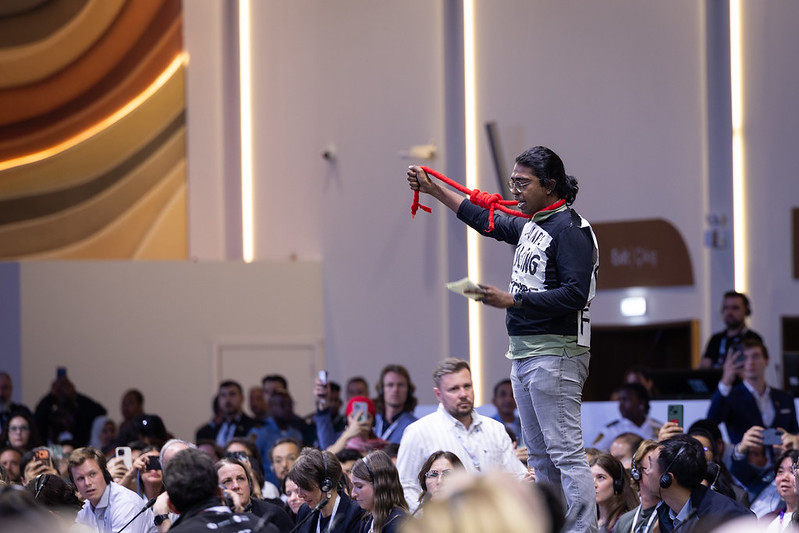
Protestor during closing plenary. Credit: UN Climate Change/Kiara Worth
Green trade barriers: Climate action or protectionism?
Developing countries challenged unilateral climate-related trade measures, particularly the European Union’s Carbon Border Adjustment Mechanism (CBAM), warning that these could undermine export competitiveness and penalise economies lacking the resources to decarbonise.
The proposed agreement called for cooperation to prevent climate measures becoming disguised trade restrictions, but the dispute remained unresolved.
A summit without consensus
Although COP31 advanced separate initiatives and technical decisions, the failure to adopt an overarching agreement exposed deep divisions over the pace of climate action and who should pay for it.
For developing countries, particularly in Africa, the outcome leaves critical questions unanswered about adaptation finance, the transition away from fossil fuels and support for vulnerable communities.
As Guterres warned: “There may be no consensus in the negotiating room. There is no ambiguity in the science.”
IPS UN Bureau Report