
LVIV, Ukraine , Nov 26 2026 (IPS) - At the end of October, the first enduring ceasefire of the nearly five-year-long Russian war against Ukraine opened the way for the rescue of children and their families trapped in the besieged town of Oleshky in the Russian-occupied Kherson Oblast, or region of southern Ukraine.
It provided relief for many people, but those who remain in the region’s frontline communities face another severe winter of deprivation under Russia’s intensified offensive.
Already civilian and child casualties of the war have reached record levels this year. About 1,144 children have been killed or maimed in Ukraine since January, with the toll in October alone 150 percent higher than the same month last year, reports UNICEF.
Yet the six-day cessation of fighting from 27 October in Oleshky, a town with a remaining population of 6,000 people, including an estimated 200 children, paved the way for a massive humanitarian and evacuation operation.
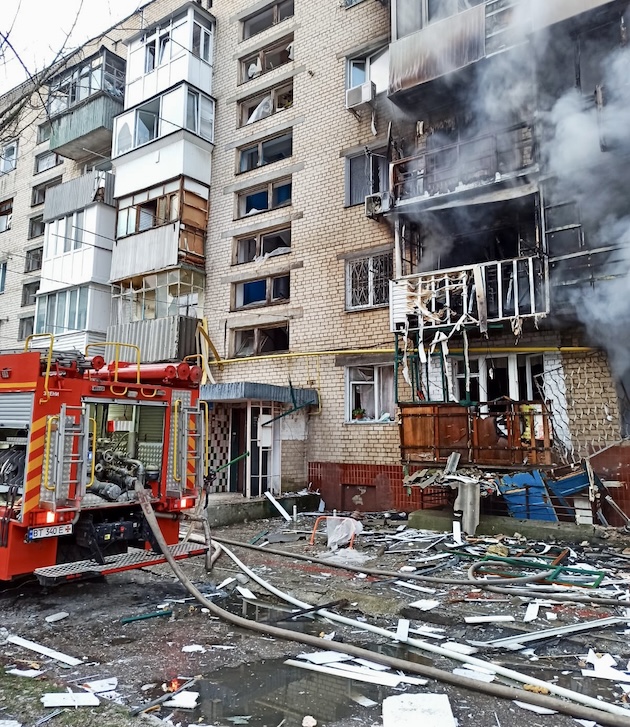
Russian shells hit a residential building in Kherson city on 15 January 2023. Kherson Oblast, Ukraine. Credit: dsns.gov.ua/Wiki Commons
Cooperation between Russian and Ukrainian authorities mediated by the First Lady of the United States, Melania Trump, enabled nearly 800 residents, including 34 children, to be evacuated by road either to Russia or to northern Ukraine. Ukrainian forces also used the pause in the conflict to organise the evacuation and relocation of 167 other vulnerable civilians, including 22 children, in the region.
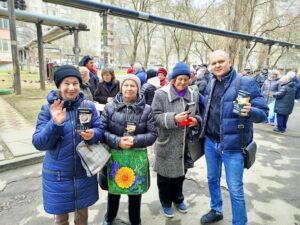
Local residents in and around Kherson city who work as volunteers with the grassroots non-profit organisation, Union of Help to Kherson, told IPS about the impacts of the ceasefire on residents.
“In the longer term, the main effect has been morale,” a spokesperson for the volunteers, who have been supporting vulnerable residents since 2022, said. “Many people told us that even simply being able to go to the cemetery and visit the graves of their relatives was a great joy. Our pro-Ukrainian people were able to feel at home again in a place where they could speak Ukrainian freely and hear the national anthem. That is what sustains people.”
Russian forces currently occupy about 70 percent of Kherson Oblast, which is located in southern Ukraine and on the northern coastline of the Black Sea. Seven months after invading in February 2022, Russia annexed Kherson territory after referendums were organised under occupation, despite claims of voter coercion and international condemnation of the unilateral move. Although the principal city of Kherson, home to about 60,000 people, was recaptured by Ukrainian forces in November 2022.
For the past four years, the lives of people in Oleshky and surrounding communities have been fraught with the lethal risk of minefields, severe flooding after large-scale damage to the nearby Kakhovka Dam, hunger due to a lack of food, and an upsurge in drone attacks.
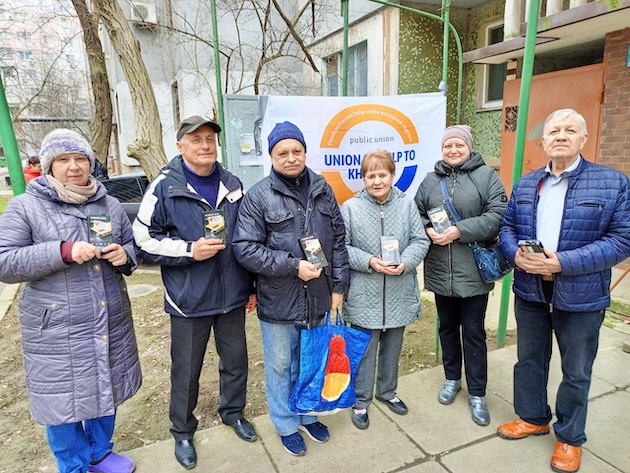
Local residents of the Tavriyskiy neighbourhood in Kherson city receive power banks and humanitarian aid from the Union of Help to Kherson non-profit organisation in 2025. Kherson Oblast, Ukraine. Credit: Union of Help to Kherson
The estimated 1,300 people who stayed in Oleshky after the humanitarian mission were provided with supplies of food, water, hygiene necessities and medicines. But after fighting resumed on 2 November, Russian forces continued their relentless attacks on communities, humanitarian facilities and energy and power infrastructure.
They follow Russian strikes in August that destroyed the thermal power plant in Kherson city.
“The damage is critical. The city’s combined heat and power plant is still not working, and it is not known whether it can be restarted: about 30 guided aerial bombs have hit it this year alone,” local volunteers said. “Power in the city is holding only thanks to the heroic efforts of our energy workers; they work without stopping,” they continued.
So far, the non-profit organisation has distributed more than 2,000 blackout survival kits, which contain a solar panel, a power bank and a light, to affected communities. But it predicts that about 5,000 kits will be needed this winter. The kit enables residents and their families to stay in touch and to follow news and air raid alerts and can power a solar-charged lamp which provides comfort and safety in homes and allows children to continue with their studies.
‘If strikes on generation and power lines continue into the cold season, children may find themselves in freezing apartments without electricity, water or hot meals, cut off from education and healthcare,’ warns a report by the Ukrainian Voices of Children foundation.
Conditions that will only increase the mental health risks to children who have witnessed death and injury, loss of family and friends and experienced displacement, traumatic stress, loss of education and isolation. And the oppressive environment for the estimated 10,600 children in Kherson communities has been worsened by up to 6,500 drone attacks every week.
“Because of the threat from the sky, children are almost never outside, deprived of fresh air and normal physical activity. Constant immobility in cold flats, under endless shelling, is an extremely hard trial for a child’s physical and psychological state,” volunteers described.
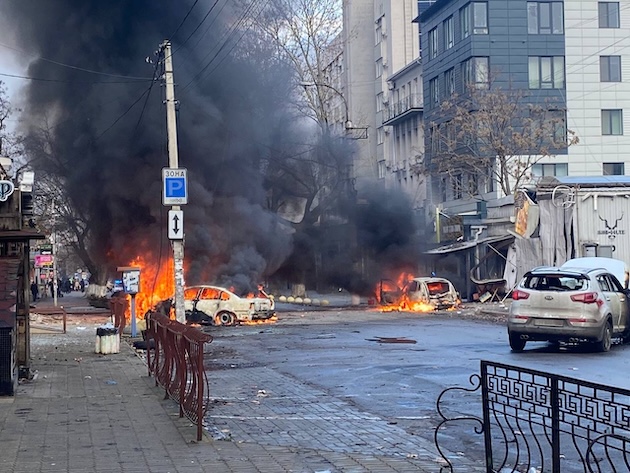
Cars burn in the city centre of Kherson after an attack by Russian forces on 24 December 2022. Kherson Oblast, Ukraine. Credit: khoda.gov.ua/Wiki Commons
Government efforts to prepare for humanitarian needs this winter began in July, and, by August, Ukraine’s Minister of Social Policy, Family and Unity, Denys Uliutin, announced that the winter response and resilience program had secured 2.2 billion Hryvnia (US$48.4 million) in funding.
The program provides families, children and their carers in more than 104,000 households in frontline communities with access to cash payments that can be used to pay for winter necessities, such as extra clothing and food, or pay energy and utility bills.
However, some of the benefits will depend on functioning energy services and access to food supplies. In the Kherson region “people’s access to food is a major concern, as any movement within the area creates a significant risk of an incident, making restocking dangerous and forcing people to stay indoors with very limited food stocks,” Guillermo Llinas, Country Director of the food security and relief organisation Action Against Hunger, in Ukraine, told IPS.
Given the absence of any breakthrough in U.S.-mediated peace talks between Russia and Ukraine held in Abu Dhabi on 10-11 November, Ukrainians are preparing for little respite over the next four months of Europe’s winter. Although Ukraine’s President, Volodymyr Zelenskyy, was reported on 17 November to be proposing further humanitarian ceasefire missions in the southern oblasts of Kherson and Zaporizhzhia, these will be dependent on the political will for new mediation efforts between Ukrainian and Russian authorities.
In the meantime, “no children should have to endure the hardships of this confrontation and find themselves in proximity of an active frontline, in particular, during the winter season,” Llinas emphasised. “Their nutritional and mental health as well as their overall wellbeing and development should not be compromised.”
IPS UN Bureau Report